
Your Shopify Fashion Store Has a Fit-Confidence Problem
A customer can love a dress, trust the brand, and still leave the product page without buying because one question has not been answered: “How will this actually look on me?” For Shopify fashion stores, AI virtual try-on is becoming an interesting way to address that hesitation, and Arlox’s Style Me is built specifically around that gap.
The Product Page Is Asking the Customer to Imagine Too Much
Most fashion product pages follow the same formula.
A few product photographs.
A model wearing the garment.
Price.
Size options.
Description.
Reviews.
Add to cart.
It looks complete.
But from the customer's perspective, something is still missing.
They can see the garment.
They can see someone else wearing it.
They can read the measurements.
What they cannot see is themselves wearing it.
That is a major difference.
Fashion is unusually dependent on visual confidence because the customer cannot physically touch the fabric, assess the drape, try the size, or look in a mirror before paying.
Shopify itself recommends using detailed product imagery, lifestyle photography, video and interactive experiences to help shoppers understand products before purchasing. Its current product-page guidance specifically mentions virtual try-ons and augmented-reality-style experiences as potential ways to give shoppers a better feel for products. (Shopify)
For a fashion brand running Meta advertising, this matters even more.
You are paying to create demand.
The product page has to convert that demand into confidence.
What Is Style Me?
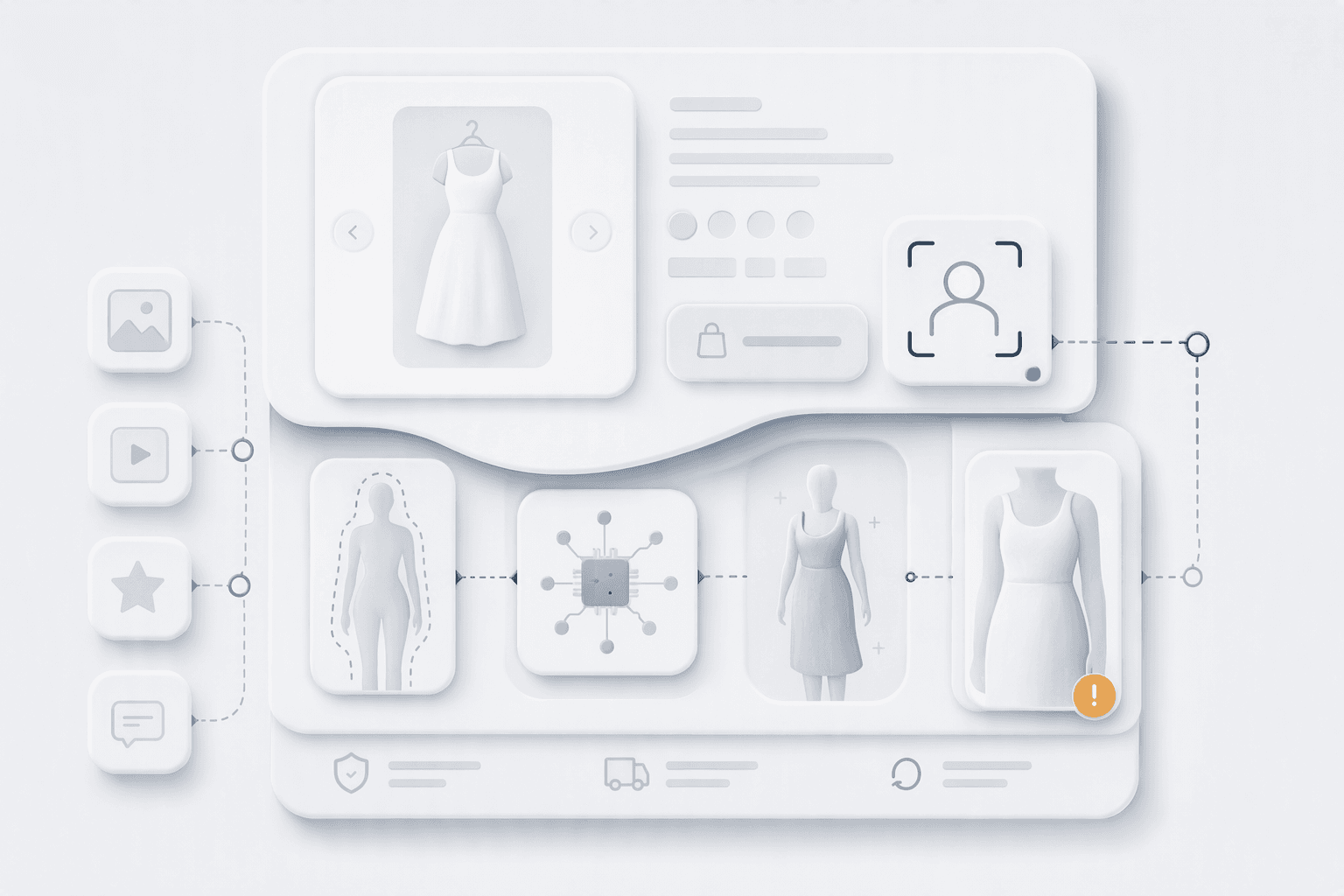
Answer: Style Me is Arlox’s photorealistic AI virtual try-on experience for Shopify fashion stores. A customer uploads a full-body image, and Style Me generates a visualisation of the selected garment on that person directly within the product-page shopping experience. Its current site states that the experience averages about 40 seconds, uses Shopify theme-app-extension integration, and is designed to feel native rather than like an intrusive popup. (Style Me)
The distinction here is important.
Style Me isn't trying to become another destination the customer has to visit.
The customer is already evaluating a product.
That is where the tool appears.
The basic journey becomes:
Discover product → open PDP → see garment → try it virtually → gain confidence → purchase.
That is much closer to the natural buying process.
It also means the feature can complement existing photography rather than replacing it.
A product photo tells the customer what the product looks like.
A virtual try-on can help answer what it might look like on them.
Why This Matters for Meta Advertising
A lot of D2C brands think of paid acquisition and CRO as two different departments.
They shouldn't be.
Imagine a Meta ad gets 1,000 highly relevant visitors to a product page.
The advertisement did its job.
But those visitors still have concerns about fit, silhouette or whether the garment will suit them.
If the page doesn't answer those questions, part of your acquisition spend is effectively paying to create uncertainty.
This is where D2C fashion performance marketing gets more interesting.
The ad is only one part of the conversion path.
The customer arrives with a question.
Your product page needs to answer it.
Arlox's Meta Ads Scaling framework looks at acquisition as a connected system rather than treating paid media as an isolated activity.
A stronger ad can increase product-page traffic.
A stronger product page can make that traffic more valuable.
And a tool such as Style Me can potentially address one of fashion ecommerce's most specific conversion barriers.
Can Virtual Try-On Increase Conversion?
Answer: It can potentially improve purchase confidence by reducing uncertainty around how a garment may look on the shopper, but performance needs to be tested store by store.
That distinction is important.
Style Me currently presents a +22% conversion lift and -40% return rate claim on its website, along with a 94% perceived-accuracy figure from customer studies. These are claims made by the product itself, not a guarantee that every Shopify merchant will see the same result. (Style Me)
A proper D2C operator should therefore treat these as hypotheses to validate.
Add the experience.
Measure usage.
Measure add-to-cart rate.
Measure purchase conversion.
Track returns.
Compare against a suitable baseline.
That's the scientific advertising mindset.
The tool is not valuable because it uses AI.
It is valuable if it improves a commercial outcome.
What Makes Style Me Particularly Relevant to Shopify Fashion Brands?
The implementation matters.
Style Me's current product information states that it uses a Shopify Theme App Extension, supports automatic theme injection, allows customizable UI colours, uses a mobile-first responsive design and is intended to have no impact on page-load speed. The website also states that installation takes under two minutes. (Style Me)
For a founder, that means the conversation is not:
“Should we build an AI product?”
It becomes:
“Can we add another confidence layer to our existing product pages without rebuilding the store?”
That's a much easier business question.
And because the experience is positioned directly on the PDP, it can be introduced at the moment the shopper is already evaluating the product.
Who Should Consider a Virtual Try-On First?
Not every ecommerce category needs it.
Fashion is one of the more logical places to test it.
Especially:
Womenswear
Customers often want to visualise silhouettes and styling before purchasing.
Menswear
Fit, proportion and overall look can influence purchase confidence.
Activewear
Body fit and garment shape are important parts of the decision.
Outerwear
Customers may want to see how a specific silhouette works on their own frame.
Bridal and occasionwear
Visual confidence becomes even more important for higher-consideration purchases.
Style Me currently lists womenswear, menswear, activewear, swimwear, outerwear, loungewear, bridal and accessories among the categories its engine is designed to support. (Style Me)
That makes the concept broader than simply putting a digital “dressing room” on one category of apparel.
What Should You Measure After Installing Style Me?
Don't measure only purchases.
Measure the complete interaction.
Usage rate: How many product-page visitors actually try it?
Add-to-cart rate: Do users who engage with the feature add products at a higher rate?
Conversion rate: Does purchase behaviour improve?
Return rate: Does expectation setting improve downstream outcomes?
AOV: Does increased confidence influence basket size?
Time to purchase: Does the customer move from consideration to action faster?
This is where Arlox's CRO Toolkit becomes relevant.
The toolkit is designed around an 80/20 approach to fashion ecommerce, with dedicated sections for product pages, imagery, sizing, objections, trust, mobile UX and checkout. It describes itself as being based on 87+ brands and includes a structured 30-day implementation roadmap. (Arlox)
Style Me can solve one specific uncertainty.
The CRO Toolkit helps identify whether there are other uncertainties around it.
Together, that's a stronger way to think about conversion optimisation.
Why Better Product Pages Matter More as Ad Spend Grows
The economics are simple.
Suppose a brand spends ₹5 lakh to bring traffic to its website.
If its product pages convert poorly, scaling Meta may simply increase the amount of expensive traffic hitting the same bottleneck.
But if the brand improves product-page performance, every future acquisition campaign benefits from that improvement.
Shopify's current guidance describes product pages as critical decision points and recommends focusing on elements such as high-quality imagery, useful product information, reviews, mobile usability, and interactive experiences that help shoppers understand products before purchase. (Shopify)
That is why CRO should not be an afterthought.
Especially for fashion brands.
Where Style Me Fits Into a Broader Growth System
Think of the funnel as:
Creative creates attention.
Offer creates interest.
Product page creates understanding.
Style Me can create personal visual confidence.
Checkout removes the final friction.
That's a much more complete view of ecommerce performance than simply asking whether Meta generated enough clicks.
For brands across India, the UAE, the UK and the US, the exact customer objections may differ.
But the fundamental problem remains:
A customer is buying a visual product without physically trying it first.
Style Me is designed to address that gap.
Explore Style Me and see how a personalised virtual try-on can sit directly inside your Shopify product pages. For a broader acquisition and CRO strategy, book a strategy call with Arlox.io.
Written by -
Evyan Kumar is Head of Marketing & Brand Growth at Arlox.io — a scientific advertising agency helping D2C fashion brands scale profitably on Meta. Based in Gurugram, India.
Arlox is a CRO and performance marketing agency for Shopify fashion stores — focused on conversion rate optimisation, checkout optimisation and the systems that turn paid traffic into profitable customers.