
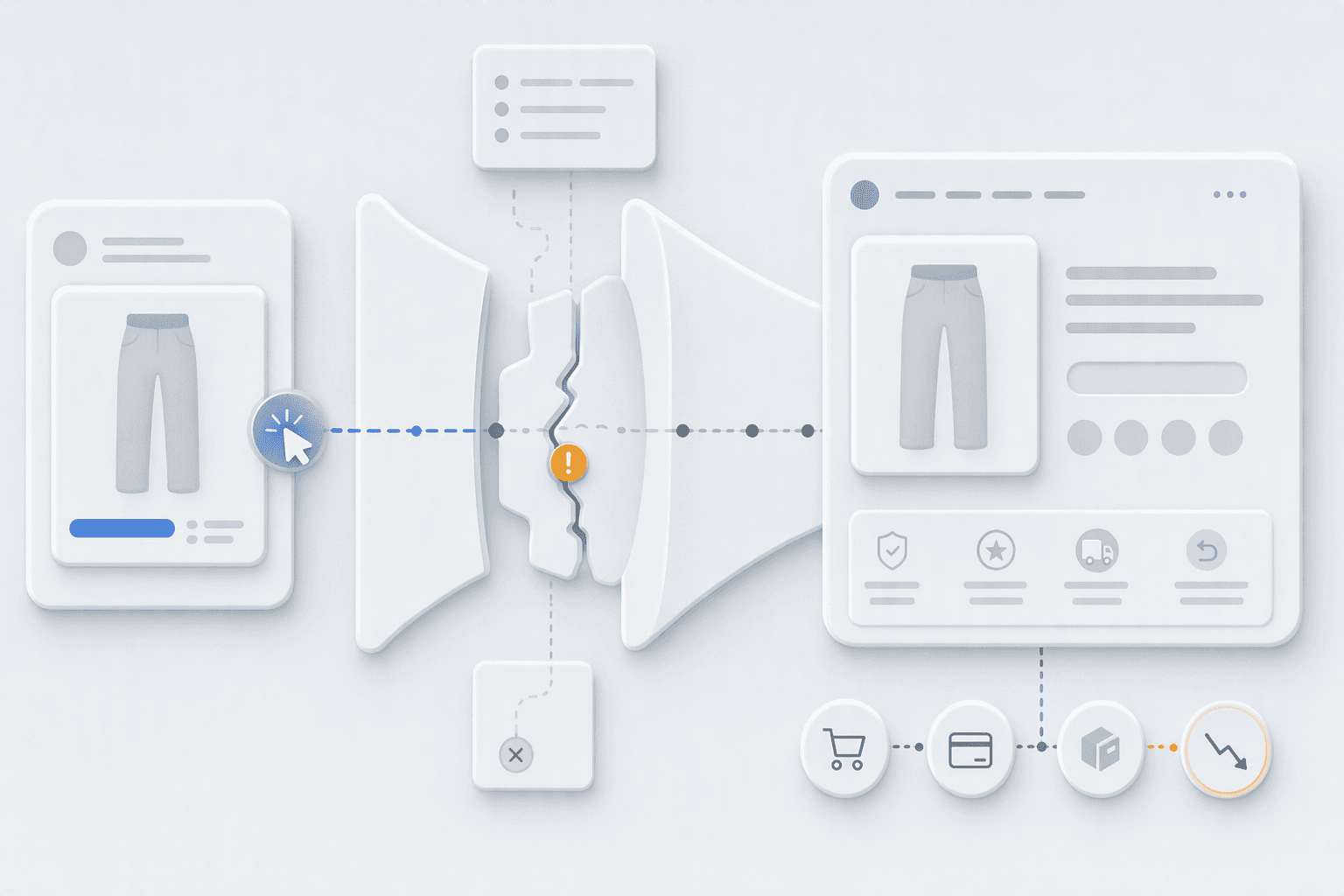
Your Meta Ad Is Working. Your Product Page Isn't.
A D2C brand launches a new Meta campaign.
The CTR looks good.
Traffic increases.
The ads are getting attention.
But sales don't follow.
The founder blames Meta.
The agency blames the creative.
The creative team makes another video.
And the same thing happens again.
Sometimes the ad has already done its job.
The product page is where the sale is being lost.
Why the Ad and Landing Page Need to Tell the Same Story
Think about the customer journey.
Your ad says:
“The everyday trousers designed to finally fit women with smaller waists and fuller hips.”
The customer clicks.
The product page says:
“Premium trousers. Shop the collection.”
You have created a communication gap.
The ad created a specific expectation.
The website replaced it with a generic product description.
That forces the customer to start evaluating the product all over again.
This is especially damaging with cold traffic.
The person didn't wake up looking for your brand.
Your advertisement created the interest.
The product page now has to continue the argument.
How Can You Tell if Your Landing Page Is Hurting Meta Performance?
Answer: Look for a healthy click-through rate followed by weak onsite engagement, add-to-cart or purchase behaviour.
This is not a perfect diagnosis, but it is a useful starting point.
Imagine:
CPM: healthy
CTR: healthy
CPC: healthy
Landing-page views: healthy
Add-to-cart: weak
Purchase conversion: weak
It would be premature to immediately blame targeting.
The traffic may be relevant.
The problem could be what happens after the click.
Shopify's marketing attribution guidance also highlights that understanding the complete customer journey requires looking beyond individual advertising platforms and considering the interactions that happen across the conversion path. (Shopify)
For a D2C fashion brand, that means examining the product page as part of the advertising system.
Not as a separate website project.
What Should a Fashion Product Page Communicate?
A cold visitor should quickly understand:
What is it?
Show the product clearly.
Why is it different?
Explain the actual product advantage.
Who is it for?
Make the intended customer obvious.
How does it fit?
Include sizing, model information and useful fit details.
Why should I trust you?
Reviews, UGC, policies and proof.
Why is it worth this price?
Explain the value.
What happens if I don't like it?
Make returns and exchanges easy to understand.
These aren't “CRO tricks.”
They answer the objections that prevent purchase.
Arlox.io's CRO Toolkit can be useful when auditing the conversion layer around paid traffic.
Should You Change the Meta Ad or the Landing Page First?
Answer: Diagnose where the biggest performance drop occurs before changing either one.
Consider three scenarios.
Scenario 1:
Low CTR.
The problem is more likely to be the creative, hook, offer or audience-message fit.
Scenario 2:
High CTR but low add-to-cart.
Investigate the product page, price, offer and message continuity.
Scenario 3:
Healthy add-to-cart but weak purchase completion.
Investigate checkout friction, shipping costs, payment options, trust and unexpected fees.
This simple funnel diagnosis prevents a common D2C mistake:
changing the wrong variable.
If your checkout is leaking customers, making another Meta video won't fix it.
If your creative is attracting the wrong people, rebuilding the entire website won't fix it.
Good performance marketing identifies the bottleneck first.
How Do You Create Ad-to-Landing-Page Continuity?
Take your strongest-performing ad.
Identify its core promise.
Then make sure the product page confirms that promise immediately.
Suppose the winning Meta angle is:
“No more uncomfortable denim after lunch.”
The landing page should not open with:
“Premium denim for the modern woman.”
Instead, the customer should immediately see the fit benefit.
For example:
“Comfortable stretch denim designed to stay comfortable all day.”
Then demonstrate it.
Show the fit.
Show the fabric.
Show different body types if appropriate.
Add reviews that reinforce the same benefit.
The customer should feel:
“Yes. This is the product I clicked for.”
That's message continuity.
What Role Does Creative Testing Play?
Creative testing can actually tell you what your product page should emphasise.
Suppose you test:
Fit angle
Fabric angle
Styling angle
Price angle
Social-proof angle
And fit consistently produces stronger purchase economics.
That is market information.
Your product page should probably give fit more prominence.
This is one reason Arlox.io treats D2C fashion performance marketing as a connected system rather than separating media, creative and CRO into isolated departments.
Our Scientific Angle Testing framework is designed to identify which commercial messages deserve greater attention.
What Are the Most Common Product-Page Mistakes?
Some of the most common:
Product benefits buried below the fold
Poor mobile imagery
Generic descriptions
No clear sizing information
Weak social proof
Confusing returns policy
Unexpected shipping charges
Too many competing messages
No clear differentiation
Ad promise not reflected on the page
For fashion brands, imagery deserves particular attention.
The customer needs to understand not just what the product looks like but how it behaves in real life.
That is why UGC, creator content, close-ups, movement and product demonstrations can often complement polished product photography.
If your Meta campaigns are generating clicks but your store isn't converting enough of them, book a strategy call with Arlox.io.
You can also explore the Arlox.io CRO Toolkit and Meta Ads Scaling.
Written by -
Evyan Kumar is Head of Marketing & Brand Growth at Arlox.io — a scientific advertising agency helping D2C fashion brands scale profitably on Meta. Based in Gurugram, India.
Arlox is a CRO and performance marketing agency for Shopify fashion stores — conversion rate optimisation, checkout optimisation for Indian D2C, server-side tracking and media buying. 450+ brands worked with. Founded by Varinder Singh Gakhar (Vann Laniakea).