
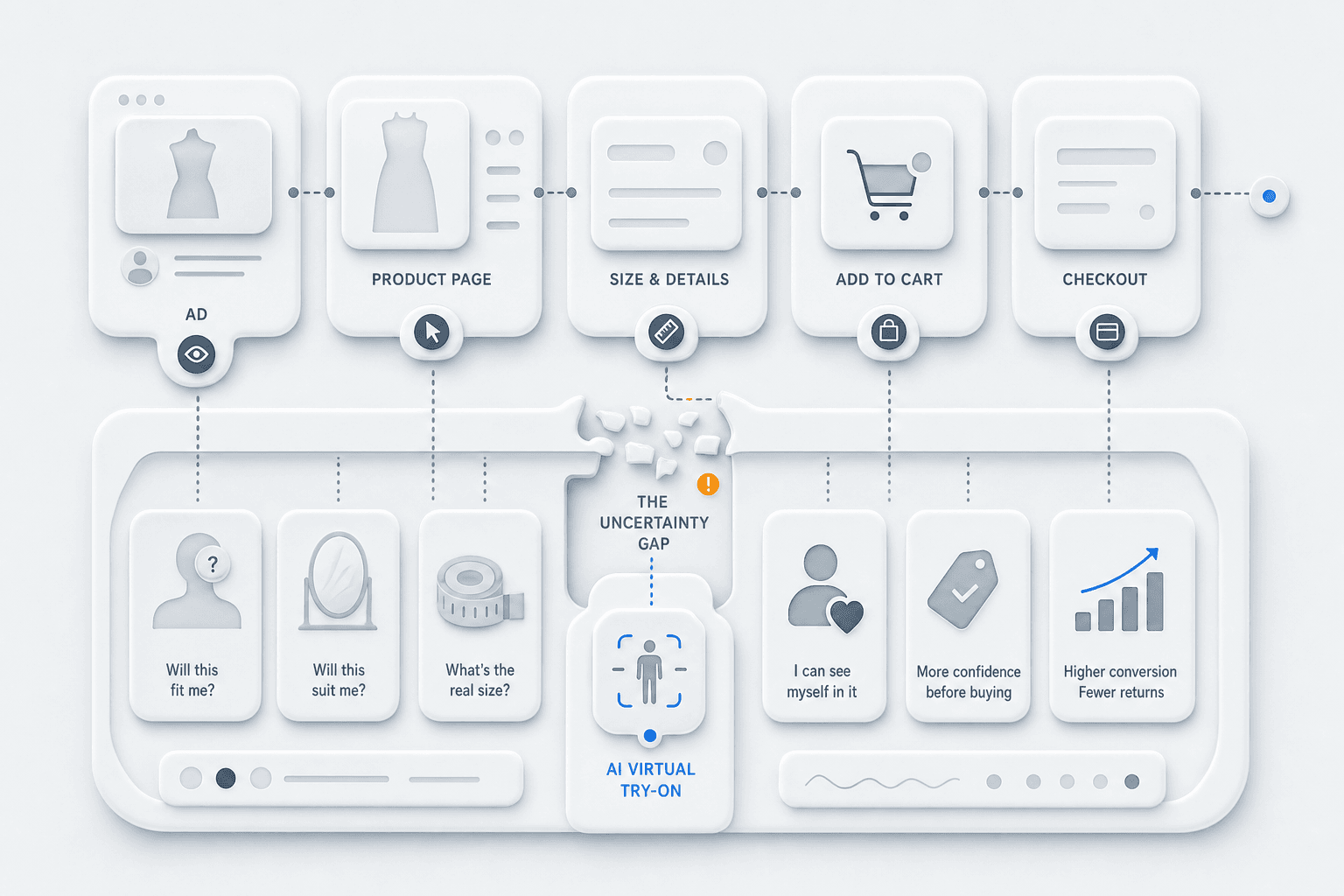
The Best Use of AI on a Fashion Store May Be Before Checkout
Most conversations about AI in ecommerce focus on content.
Generate product descriptions.
Generate ad copy.
Generate images.
Generate social posts.
Useful, but none of those solves the customer's biggest fashion-specific problem:
“Will I actually look good in this?”
That is why AI virtual try-on is worth looking at differently. Instead of using AI to create more marketing content, fashion brands can use it to change what happens after the customer clicks the ad.
AI Doesn't Have to Make More Content
There's already a huge amount of content on the internet.
Fashion brands have product photography.
UGC.
Influencer content.
Reels.
Carousels.
Founder videos.
AI can make more of all of it.
But more content doesn't automatically solve the buying problem.
A customer may have seen ten photographs of the same dress and still hesitate.
Why?
Because none of those images answer the personal question:
“What will it look like on me?”
That's where AI becomes more commercially interesting.
The value isn't:
AI generated image = cool technology.
The value is:
Personalised visualisation = less uncertainty.
Shopify's own ecommerce guidance currently recommends rich product media, videos, 3D and augmented-reality-style experiences because interactive media can improve a customer's understanding and confidence in a product.
That makes virtual try-on a legitimate CRO conversation rather than simply an AI trend.
What Is Style Me?
Answer: Style Me is a Shopify-focused AI virtual try-on experience from Arlox. The customer uploads a full-body photo, selects a garment, and receives a high-fidelity visualisation of that garment on themselves. The current implementation is designed to live natively within product pages, with a mobile-first interface and Shopify Theme App Extension support.
The integration is important.
A separate virtual styling application might create another step.
Style Me is positioned to keep the experience within the store.
The customer doesn't need to mentally translate:
model → my body → my styling.
They can see a personalised version directly.
That is a different form of product discovery.
Why the Post-Click Experience Matters
Answer: Because Meta can create interest, but it cannot close the uncertainty that exists on your product page.
This is where many D2C brands get the sequence wrong.
They spend weeks improving:
Hooks
Creatives
Targeting
Campaign structure
But barely touch the product page.
The customer clicks the ad and lands on a page where the product still needs to prove itself.
For cold traffic, that can be expensive.
A Meta campaign can produce excellent traffic quality while the store fails to convert enough of that traffic.
This is why Arlox's approach to Scientific Angle Testing treats creative as one part of a broader acquisition system.
The winning ad can only do so much.
The store has to complete the argument.
What Happens When the Product Becomes Personal?
There is a psychological difference between seeing a product and seeing yourself with the product.
A model wearing a dress creates aspiration.
A customer wearing a visualisation creates personal relevance.
That can change the internal question.
Instead of:
“Does this look good?”
it becomes:
“Do I like how I look in this?”
That is much closer to an actual purchase decision.
And this isn't limited to womenswear.
The Style Me site currently presents support across womenswear, menswear, activewear, swimwear, outerwear, loungewear, bridal and accessories.
That means the underlying idea can be applied across several fashion business models.
Can Virtual Try-On Reduce Returns?
Answer: It may help reduce returns caused by expectation mismatch, but it does not eliminate sizing, quality, preference or other reasons customers return products.
This distinction matters.
Style Me currently advertises a 40% reduction in returns as a product claim. It also states a 22% conversion-lift claim and reports 94% perceived accuracy in customer studies.
A serious ecommerce operator should not assume those figures automatically transfer to their store.
Instead, establish a baseline.
For example:
Current return rate: 18%
Current PDP conversion: 1.9%
Then deploy the experience to a representative set of traffic.
Measure:
Try-on engagement
PDP conversion
Return rate
Average order value
Repeat purchase
Now you have evidence.
That's better than judging the tool by how impressive the demo looks.
The Bigger Opportunity Is Expectation Management
This may actually be more important than the AI itself.
Fashion returns often begin with a gap between what the customer expected and what arrived.
The customer expected one silhouette.
The garment arrived and felt different.
They expected one fit.
The actual fit felt different.
They expected a particular look.
The product didn't match the mental picture.
That is expectation mismatch.
Better product photography helps close the gap.
Video helps.
Reviews help.
Sizing information helps.
Virtual try-on creates another layer of expectation setting.
Shopify's current product-page guidance similarly emphasises that strong visual and product information helps customers make more confident purchase decisions before the order is placed.
Where Style Me Should Actually Appear
Placement matters.
You don't want the customer discovering the feature after they've already scrolled through 20 sections.
It needs to appear close to the buying decision.
That's one reason Style Me's native product-page approach is important. The current product experience places the feature directly into the PDP rather than using an intrusive popup.
For a fashion brand, a logical sequence might be:
Product image
Price
Key proposition
Size selection
Style Me
Add to cart
The exact layout depends on the store.
The principle doesn't:
Put uncertainty reduction close to the point of uncertainty.
How Does This Fit With CRO?
This is where Style Me should not be treated as a standalone gimmick.
Suppose your product page has:
Weak product imagery.
No useful size guidance.
No reviews.
Slow mobile UX.
Unclear shipping.
And then you add virtual try-on.
You haven't solved your conversion problem.
You've added one sophisticated feature to a page with several basic problems.
Arlox's CRO Toolkit approaches fashion ecommerce through those fundamentals first. Its current framework covers homepage, collections, product pages, design, themes, apps, trust and checkout, with a stated focus on identifying the small set of changes that can drive a disproportionate share of improvements.
That's the right order:
Fix fundamentals → identify friction → add the right intervention → measure.
Does AI Virtual Try-On Replace UGC?
No.
UGC proves that real customers wear the product.
Virtual try-on personalises the experience.
They solve different problems.
A strong fashion PDP might therefore include:
Studio imagery for clarity.
Lifestyle photography for context.
UGC for credibility.
Reviews for social proof.
Style Me for personal visualisation.
Shopify's current guidance supports combining clear product imagery with interactive media rather than relying on one format alone.
That is a much more useful way to think about AI.
Not as a replacement.
As another layer.
Why This Could Become More Important as Paid Acquisition Gets Expensive
When customer acquisition costs rise, every improvement after the click becomes more valuable.
You don't always need more visitors.
You may need more value from the visitors you're already buying.
That's especially relevant to D2C fashion brands running Meta advertising in India, the UAE, UK and US markets.
The acquisition system brings the customer to the store.
The ecommerce experience has to do the rest.
And for fashion, one of the biggest unanswered questions is still:
“Will this look right on me?”
Style Me is built around that exact question.
CTA
See how Style Me can be added to a Shopify fashion store, or book a strategy call with Arlox.io to evaluate it alongside your acquisition and CRO system.
AUTHOR BIO
Evyan Kumar is Head of Marketing & Brand Growth at Arlox.io — a scientific advertising agency helping D2C fashion brands scale profitably on Meta. Based in Gurugram, India.
Arlox is a CRO and performance marketing agency for Shopify fashion stores — focused on conversion rate optimisation, checkout optimisation and the systems that turn ecommerce traffic into profitable customers.