
The 80/20 CRO Audit Every Shopify Fashion Brand Should Run Before Scaling Ads
A fashion brand can spend ₹5 lakh on Meta and still have a website that quietly destroys a large portion of that traffic.
The answer is not always another campaign.
Sometimes the biggest opportunity is already sitting inside the Shopify store.
The question is: which part should you fix first?
That's where an 80/20 CRO framework becomes useful.
Why Fashion Stores Don't Need More Changes. They Need Better Priorities.
The average Shopify store has dozens of potential optimisation ideas.
Change the theme.
Rebuild the homepage.
Add reviews.
Add popups.
Change the CTA.
Add bundles.
Improve the checkout.
Add more images.
Add more apps.
The problem is that founders often try to do all of them.
That creates another problem:
You no longer know what actually mattered.
An 80/20 approach starts differently.
Find the small set of issues likely responsible for a disproportionate share of the lost conversions.
Then fix those first.
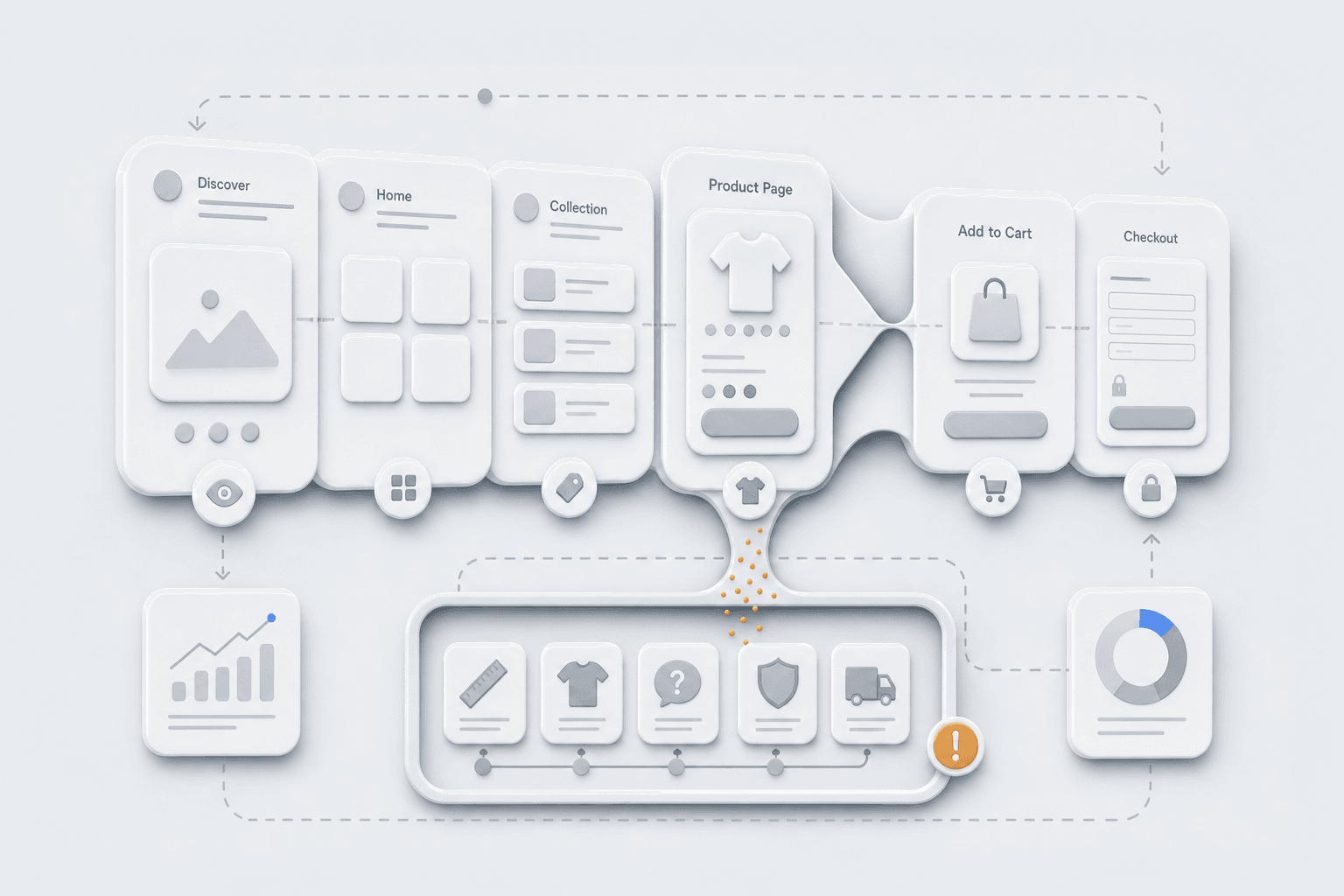
Arlox's CRO Toolkit is built around this principle. The current toolkit describes itself as an “80-20 Fashion E-commerce Playbook,” says it is based on 87+ brands, and organises the audit around the homepage, collection pages, product pages, design, themes, app stack, trust and checkout.
That's much more useful than a generic “50 ecommerce optimisation tips” checklist.
Where Should a Fashion Brand Start Its CRO Audit?
Answer: Start with the pages and actions closest to revenue, especially high-traffic product pages and checkout, before spending weeks redesigning the entire site.
Your homepage matters.
But if a customer has already clicked an ad, selected a product and reached the PDP, that's a much stronger buying signal.
At that stage, the page needs to answer:
What is this?
Why should I want it?
Why is it worth this price?
Will it fit?
Can I trust this brand?
Can I return it?
How quickly will it arrive?
Those are commercial questions.
Shopify's 2026 product-page guidance similarly emphasises clear pricing, variants, availability, informative descriptions, product imagery, reviews, social proof and interactive elements as important parts of a conversion-oriented PDP.
That's why the product page deserves disproportionate attention.
The Product Page Is Your Digital Salesperson
Answer: Because it has to do the work a salesperson would perform in a physical store: explain the product, answer objections and provide enough confidence to justify the purchase.
The Arlox CRO Toolkit describes the product page as the store's “digital salesperson” and specifically includes an 8–12 image rule, size-guide strategy and objection handling in its product-page module.
The precise number of images isn't a universal law.
The underlying idea is more important.
One photograph rarely answers every question.
For apparel, useful product media might include:
Front view
Back view
Close-up
Lifestyle shot
Full-body fit
Movement
Fabric/detail
Multiple colour or variant views
Shopify also recommends multiple angles, high-quality imagery, video and interactive media to help customers understand a product they cannot physically inspect.
You're not adding media for decoration.
You're removing questions.
How Do You Know What to Fix First?
Look at the funnel.
If visitors aren't reaching the product page, your acquisition or navigation may be the issue.
If product-page traffic is healthy but add-to-cart is weak, investigate:
Product communication
Pricing
Offer
Fit information
Visuals
Reviews
Trust
If add-to-cart is strong but checkout completion is poor, investigate:
Shipping
Payment options
Unexpected costs
Checkout friction
Trust
The current Arlox CRO Toolkit separates these layers into dedicated modules rather than treating “website conversion” as one generic problem.
That makes optimisation much more actionable.
What Does an 80/20 Audit Look Like in Practice?
Let's say a store has 100,000 monthly visitors.
The founder has a list of 40 website changes.
Don't start with all 40.
Start with the five most likely revenue bottlenecks.
For example:
1. Mobile PDP is unclear
2. Size guidance is buried
3. Product imagery doesn't show fit
4. Shipping costs appear too late
5. Checkout has unnecessary friction
Fix those.
Measure.
Then move to the next layer.
That's why the Arlox CRO Toolkit provides a 30-day execution roadmap instead of encouraging stores to change everything simultaneously. Its current roadmap sequences foundation and trust, urgency, social proof and checkout work across four weeks.
The principle is simple:
Sequence matters.
Should You Redesign the Whole Shopify Store?
Usually not as a first move.
A complete redesign sounds productive.
But it can create a huge number of simultaneous variables.
When conversion changes afterward, you don't know which intervention caused it.
A focused CRO process is more disciplined.
Change one meaningful part.
Track the effect.
Then decide what comes next.
Shopify's current guidance on product-page optimisation also recommends focused changes to important pages rather than assuming every store needs a total redesign.
This becomes especially valuable for D2C brands already spending on Meta.
You're trying to improve the commercial output of traffic.
Not win a design award.
Where Does Style Me Fit in an 80/20 Audit?
Once the basic PDP fundamentals are working, identify category-specific friction.
For fashion, one of the biggest examples is:
“I can't picture myself wearing it.”
That's where Style Me becomes interesting.
Style Me lets shoppers upload a full-body image and generate a personalised visualisation of a selected garment directly within the product page. The current product site describes a native Shopify integration, mobile-first design, approximately 40-second average generation time, and a theme-app-extension setup.
It's a very different intervention from adding another trust badge.
A trust badge addresses:
“Can I trust this store?”
Style Me addresses:
“Can I see myself in this product?”
Both may matter.
But they solve different objections.
How Should You Measure a CRO Improvement?
Choose a primary KPI before launching the test.
For a PDP change, that could be:
Purchase conversion rate
or:
Add-to-cart rate
Then establish guardrails:
AOV
Return rate
Revenue per visitor
Contribution margin
A change that increases add-to-cart rate but causes lower-quality orders isn't necessarily a win.
That's why the unit economics need to sit beside the UX metrics.
This is also where Arlox's performance marketing approach differs from purely aesthetic CRO.
A page isn't better because it looks better.
It's better because it produces better commercial behaviour.
Why CRO Becomes More Valuable During Ecommerce Scaling India
Suppose paid traffic costs ₹200 per visitor.
Improving acquisition efficiency matters.
But increasing the percentage of those visitors who buy matters too.
A store converting at 1.5% and one converting at 2.5% are fundamentally different acquisition businesses, even if they sell the same product and have the same ads.
That leverage becomes increasingly significant as spend grows.
Whether the traffic comes from Meta in India or from campaigns in the UAE, UK or US, the principle remains:
The more you pay for traffic, the less sense it makes to ignore what happens after the click.
CTA
Run your store through the Arlox CRO Toolkit and identify the highest-impact areas worth fixing first. For a combined acquisition and conversion diagnosis, book a strategy call with Arlox.io.
AUTHOR BIO
Evyan Kumar is Head of Marketing & Brand Growth at Arlox.io — a scientific advertising agency helping D2C fashion brands scale profitably on Meta. Based in Gurugram, India.
Arlox is a CRO and performance marketing agency for Shopify fashion stores — focused on conversion rate optimisation, checkout optimisation and the systems that decide whether more paid traffic actually produces more profitable growth.