
Your Meta ROAS Target Might Be Wrong Before You Launch the Campaign
A founder tells the agency:
“We need a 4X ROAS.”
The agency agrees.
The campaign launches.
Everyone watches Ads Manager.
4X becomes the definition of success.
But there is a problem.
Why 4X?
Did the business actually need 4X?
Or did someone just decide that 4X sounds good?
For D2C brands, the more useful number comes from the business itself:
break-even ROAS.
ROAS Is a Marketing Metric. Break-Even ROAS Is an Economic Number.
ROAS tells you how much revenue you generated relative to advertising spend.
Break-even ROAS tells you how efficient advertising must be before the acquisition economics stop losing money.
Those are completely different questions.
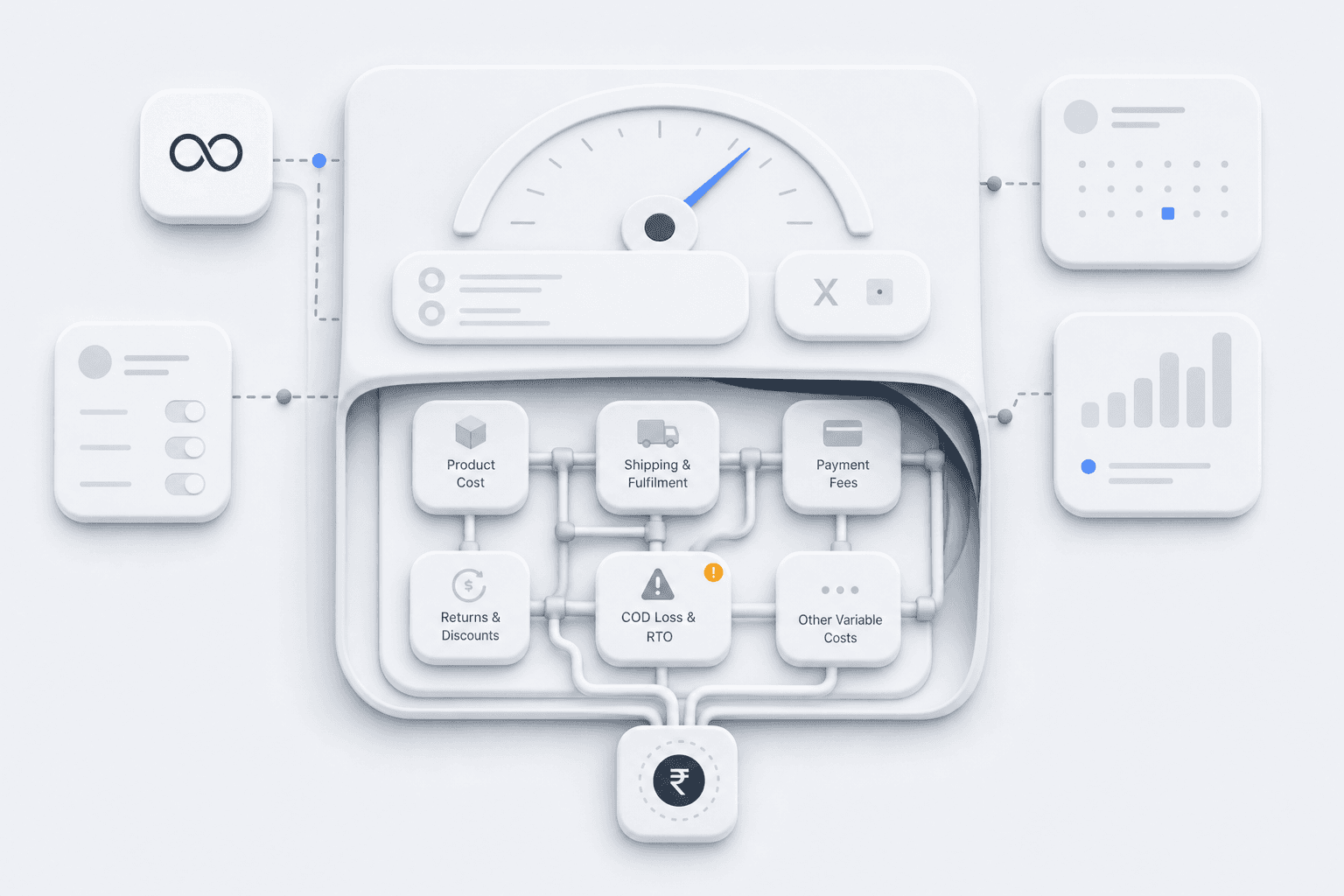
Imagine a product sells for ₹3,000.
You deduct:
₹1,000 product cost.
₹250 shipping and fulfilment.
₹100 payment and transaction costs.
₹150 in other variable costs.
You're not left with ₹3,000 to spend on advertising.
You're left with the contribution available to absorb acquisition cost and eventually produce profit.
That's why a ROAS target should come after understanding the economics.
Not before.
How Do You Calculate Break-Even ROAS?
Answer: In a simplified model, break-even ROAS is the reciprocal of the contribution margin available before advertising.
For example:
If your pre-ad contribution margin is 25%:
Break-even ROAS = 1 ÷ 0.25 = 4X
If it is 40%:
Break-even ROAS = 1 ÷ 0.40 = 2.5X
Same advertising platform.
Different business economics.
This is why there is no universal “good ROAS” for D2C fashion brands.
A 3X ROAS could be excellent for one business and unprofitable for another.
The correct benchmark comes from the economics of the product and customer.
Why Arlox Built BROAS
This is the problem BROAS is designed to help merchants understand.
BROAS is Arlox's Ecommerce Profit Intelligence tool.
The current tool accepts inputs such as:
Average Order Value
Product Unit Cost
Shipping Cost
Pick/Pack, 3PL & Fulfilment
Payment Gateway Fees
Marketing Budget
Target ROAS
It then presents outputs including:
Projected Profit
Break-Even ROAS
MER Index
Scaling ROAS
It also includes a profit-sensitivity matrix across different spending and ROAS levels.
The important part is not the calculator itself.
It is the discipline of starting with economics.
Before asking:
“How much can Meta scale?”
Ask:
“What does profitable acquisition actually look like for this business?”
What Happens When You Scale a 5X ROAS Campaign?
This is where founders get trapped.
Suppose you're spending:
₹20,000/day at 5X ROAS.
You increase the budget.
Then:
₹40,000/day → 4X
₹80,000/day → 3.3X
₹1.5 lakh/day → 2.7X
At some point the business has to decide whether the additional revenue is worth the additional acquisition cost.
That's scaling economics.
Not simply campaign performance.
BROAS explicitly surfaces a scaling ROAS figure alongside break-even ROAS and projected profit so merchants can think about this relationship before making budget decisions.
That's a much better conversation than:
“Can we get 5X?”
The real question is:
“What level of ROAS produces worthwhile profit at the spend level we want?”
Why AOV Alone Doesn't Tell You Enough
A ₹5,000 AOV sounds better than a ₹2,500 AOV.
But not necessarily.
The ₹5,000 product might cost ₹3,500 to fulfil.
The ₹2,500 product might cost ₹800.
That's why AOV needs context.
The same applies to:
Discounts
Returns
Shipping
COD
Payment costs
Fulfilment
Product costs
You cannot calculate meaningful acquisition economics from revenue alone.
This is exactly why Arlox's unit-economics positioning focuses on CM1/CM2, RTO reduction and COD-to-prepaid conversion alongside performance marketing.
The goal isn't simply:
Get the order.
It's:
Make the order economically worthwhile.
Should Every Product Have the Same ROAS Target?
Answer: No.
A high-margin product may tolerate a lower first-order ROAS.
A low-margin product may require a higher one.
A product with strong repeat purchase may justify a different acquisition threshold.
A product with high return rates may need more conservative economics.
That's why setting one account-wide number such as “4X ROAS” can hide important product-level differences.
Instead, think about:
Product economics
Customer acquisition cost
Contribution
Repeat behaviour
Return rate
Scale potential
That's a much more intelligent way to evaluate Facebook ads for fashion brands.
What Is MER and Why Should Founders Care?
ROAS evaluates a particular advertising relationship.
MER looks at marketing efficiency more broadly by comparing total revenue with total marketing spend.
It answers a different question:
“How efficiently is the overall marketing engine generating revenue?”
This becomes useful when brands operate multiple acquisition channels.
For example:
Meta.
Google.
Creators.
Affiliate.
WhatsApp.
Email.
Each platform will naturally want credit for conversions.
The business needs to know the combined outcome.
BROAS currently includes an MER Index alongside its break-even and scaling calculations.
That's important because scaling is rarely about one channel forever.
It's about whether the entire acquisition system remains economically healthy.
Why Contribution Margin Should Sit Beside Your Meta Dashboard
A Meta campaign can report an attractive ROAS while the business is struggling.
The platform sees revenue.
The founder sees:
Returns
Shipping
Product costs
Discounts
COD losses
Fulfilment
Payment fees
Customer support
The business has to pay those bills.
That's why scientific advertising needs a financial layer.
A creative may produce a great click-through rate.
A campaign may produce a strong ROAS.
But if the resulting customer economics are poor, scaling the campaign faster simply makes the problem larger.
When Should You Use BROAS?
Use it before making a major budget decision.
Especially when:
Launching paid acquisition
Increasing Meta spend
Changing AOV
Changing product pricing
Increasing discounts
Entering another market
Evaluating a new product
Comparing growth scenarios
A founder in India expanding into the UAE or US can also use the same framework with market-specific assumptions.
The inputs change.
The financial question doesn't.
What can we afford to pay to acquire a customer and still have a business worth scaling?
Put your actual economics into BROAS before setting the next ROAS target. For a deeper look at Meta acquisition and profitable scaling, book a strategy call with Arlox.io.
Written by -
Evyan Kumar is Head of Marketing & Brand Growth at Arlox.io — a scientific advertising agency helping D2C fashion brands scale profitably on Meta. Based in Gurugram, India.
Arlox is a performance marketing agency for D2C fashion brands, working on profitable scaling, RTO reduction, COD-to-prepaid conversion, and the CM1/CM2 repair that decides whether growth is worth having. 450+ brands worked with, with hundreds of on-camera founder interviews on record. Founded by Varinder Singh Gakhar (Vann Laniakea).