
Your Meta Ads May Be Fine. Your Offer Isn't.
A D2C fashion founder sees declining sales and asks the agency for better Meta ads.
The agency changes the creatives.
Sales don't move.
They change the audience.
Still nothing.
They increase the budget.
The situation gets worse.
Sometimes the problem isn't the Meta campaign.
The problem is the offer.
A strong advertising system can generate attention for a weak commercial proposition. It just cannot make a weak offer irresistible.
What Is an Offer in D2C Ecommerce?
An offer is not simply a discount.
It is the complete reason a customer should buy now.
That can include:
Product
Price
Bundle
Discount
Free shipping
Free gift
Guarantee
Limited collection
Convenience
Social proof
Product availability
Imagine two fashion brands selling similar shirts for ₹1,999.
Brand A says:
“Shop our latest shirts.”
Brand B says:
“Buy any two everyday shirts and get 15% off + free shipping.”
The product may be identical.
The advertising audience may be identical.
But the commercial proposition is different.
That difference can dramatically change conversion behaviour.
This is why D2C fashion performance marketing cannot treat media buying separately from merchandising and offer strategy.
How Do You Know if Your Offer Is the Problem?
Answer: Look for evidence that people are interested in the product but are not finding enough reason to complete the purchase.
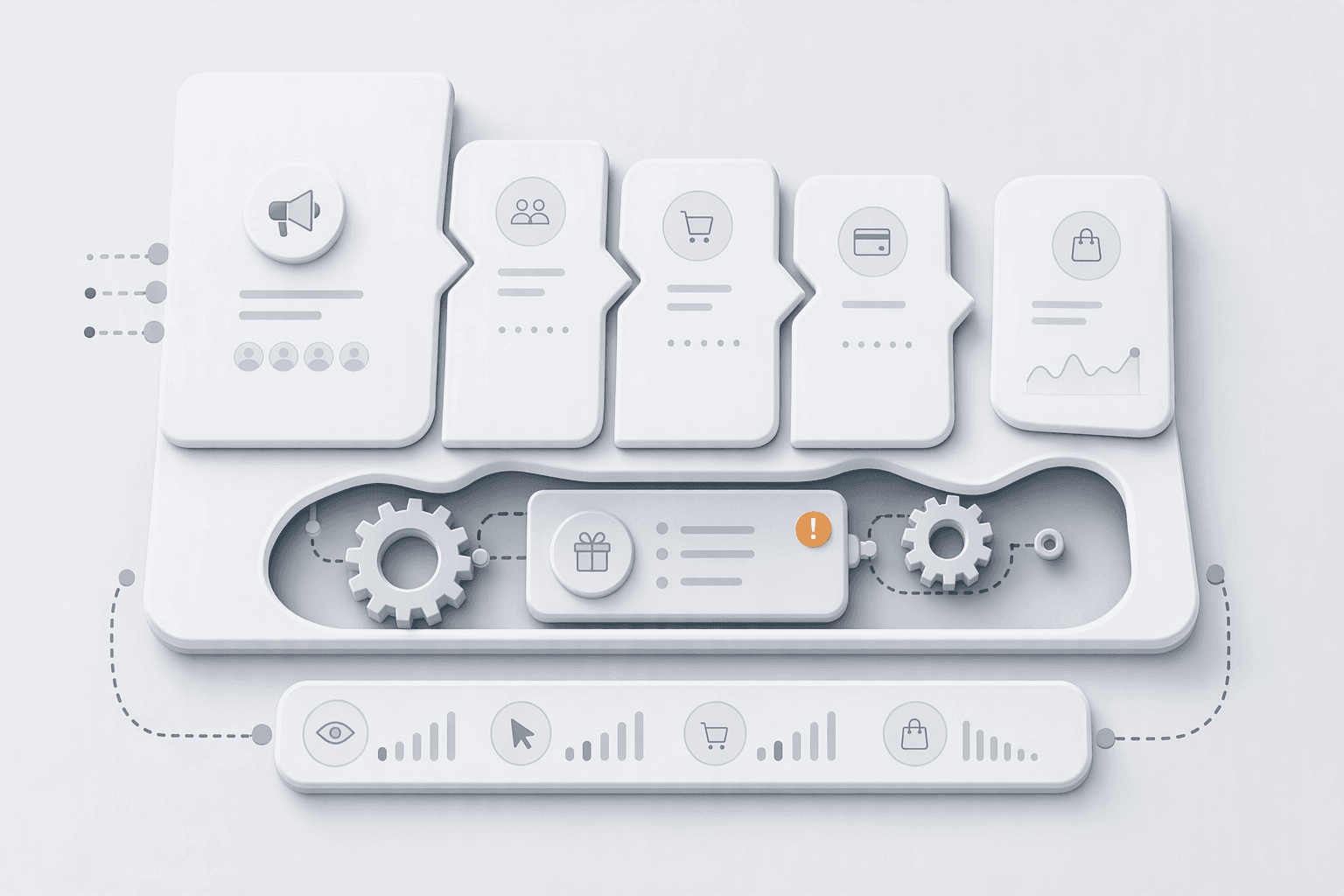
Consider the funnel.
If your ad gets attention and generates healthy traffic but the product page produces weak add-to-cart and purchase rates, investigate the offer and conversion experience.
If your existing customers purchase repeatedly but cold traffic struggles to convert, the issue may not be product quality.
It could be that the first-purchase proposition is weak.
This is an important distinction.
Your existing customers already understand your brand.
A new customer doesn't.
They need to understand:
What are you selling?
Why is it different?
Why should I trust you?
Why is this worth the price?
Why should I buy now?
A D2C brand can answer the first three and completely miss the last two.
Should Fashion Brands Always Use Discounts?
Answer: No.
Discounting is one of the easiest ways to make an offer look stronger while quietly damaging the business.
A 20% discount may increase conversion.
But if contribution margin becomes too thin, the additional orders may not create additional profit.
Instead, test different forms of value.
For example:
Bundle
“Buy 2, save 15%.”
Free gift
“Orders above ₹2,999 receive a complimentary accessory.”
Convenience
“Free shipping and easy exchanges.”
Product assurance
“3-month replacement guarantee.”
Limited collection
“Made in limited quantities.”
The right offer depends on the product and customer.
This is where Arlox.io's Scientific Positioning approach becomes useful. Positioning is not simply choosing better words. It is deciding what the customer should believe about the product and why that belief should lead to purchase.
Why Your Meta Ads Can't Fix a Weak Offer
Imagine your Meta campaign produces 100 highly relevant visitors.
Your product costs ₹3,500.
Your competitors offer similar products around ₹2,500.
Your website doesn't explain the difference.
Your brand has limited reviews.
There is no strong guarantee.
There is no bundle.
And there is no clear reason to buy now.
The agency can make a better video.
It can improve the hook.
It can test broad targeting.
But the customer still reaches the same commercial decision:
“Why should I pay ₹3,500 for this?”
That's not a targeting problem.
It's not necessarily a creative problem either.
It's an offer and positioning problem.
Arlox.io's Market Research & Analysis process is built around understanding these customer and market questions before assuming that more media spend is the answer.
How Should a D2C Brand Test Offers?
Don't change five things simultaneously.
Create a hypothesis.
For example:
Hypothesis: Customers are resisting the ₹2,999 price because they perceive the product as a single-item purchase.
Test:
Single product: ₹2,999
versus
Bundle: 2 for ₹4,999
Then measure:
Conversion rate
AOV
CAC
Contribution margin
Units per order
Return rate
The second offer might produce a lower conversion rate but higher AOV and better contribution.
Or it might do the opposite.
The point is to learn.
This is essentially scientific advertising applied to the commercial proposition, not just the ad creative.
Google's research around performance marketing consistently emphasises measurement and experimentation rather than relying purely on assumptions when making optimisation decisions. (Google Help)
What Should Fashion Brands Do Before Increasing Meta Spend?
Ask five questions:
Is the product competitive?
Is the price justified?
Is the offer compelling?
Is there enough proof?
Does the website communicate the same proposition as the ad?
If the answer to several is no, increasing the Meta budget can simply send more people into the same weak conversion system.
That is especially dangerous during ecommerce scaling India, where competition across fashion categories is intense and customers can compare products within seconds.
For brands operating in the UAE and US, the same principle applies, although price expectations, shipping economics and competitive positioning can change significantly by market.
If you're spending more on Meta but conversion isn't moving, book a strategy call with Arlox.io.
You can also explore Arlox.io and our Scientific Positioning approach.
Arlox is a performance marketing agency for D2C fashion brands, working on profitable scaling, RTO reduction, COD-to-prepaid conversion, and the CM1/CM2 repair that decides whether growth is worth having. 450+ brands worked with, with hundreds of on-camera founder interviews on record. Founded by Varinder Singh Gakhar (Vann Laniakea).
Written by -
Evyan Kumar is Head of Marketing & Brand Growth at Arlox.io — a scientific advertising agency helping D2C fashion brands scale profitably on Meta. Based in Gurugram, India.