
When Meta Ads Aren't the Problem
Revenue falls 25%.
The founder opens Ads Manager.
ROAS is down.
The conclusion seems obvious:
“Meta isn't working.”
But sometimes Meta is only the first number you noticed.
The actual problem could be your product, pricing, offer, website, inventory, seasonality, fulfilment or customer experience.
Before changing the campaign, you need to identify the bottleneck.
How Do You Diagnose a D2C Revenue Drop?
Answer: Follow the customer journey backwards instead of starting with the ad account.
Start with revenue.
Then ask:
Did traffic fall?
If yes, investigate acquisition.
Did traffic remain stable but conversion fall?
Investigate the website, offer, product or customer experience.
Did conversion remain stable but AOV fall?
Investigate pricing, discounts and product mix.
Did orders increase but profit fall?
Investigate CAC, contribution margin, returns and discounting.
This creates a diagnostic tree.
Without it, founders often make the most expensive mistake:
They change the part of the business they understand least.
If you're a founder, Ads Manager gives you an enormous amount of information.
That doesn't mean it gives you the answer.
What If Meta ROAS Drops but the Business Is Healthy?
This can happen.
Suppose:
Meta ROAS falls from 4X to 3.2X
Shopify revenue increases
New customers increase
Blended CAC remains acceptable
Contribution margin improves
Should you panic?
Probably not.
The Meta number alone doesn't tell you the full story.
Attribution systems assign credit differently. Google Analytics, for example, explains that different attribution models can produce different allocations of revenue and conversions across marketing touchpoints. (Google Help)
This is why the correct question isn't:
“Did Meta ROAS go down?”
It's:
“Did the economics of acquiring another customer become worse?”
Those are not always the same thing.
What If Meta ROAS Is Stable but Revenue Is Falling?
This is more interesting.
Imagine:
Meta ROAS: 3.5X → 3.5X
But total store revenue:
₹50 lakh → ₹40 lakh
The Meta campaign may be behaving consistently.
The business isn't.
Possible explanations:
Organic traffic declined
Repeat purchase declined
Google traffic declined
Inventory was unavailable
Average order value decreased
Existing customers bought less
A major promotion ended
Seasonality changed
This is why D2C performance marketing should look at the entire acquisition and revenue ecosystem.
Shopify similarly describes attribution as a way to understand the many interactions customers can have with a business before conversion rather than reducing the customer journey to one channel. (Shopify)
What Are the Six Bottlenecks Every D2C Founder Should Check?
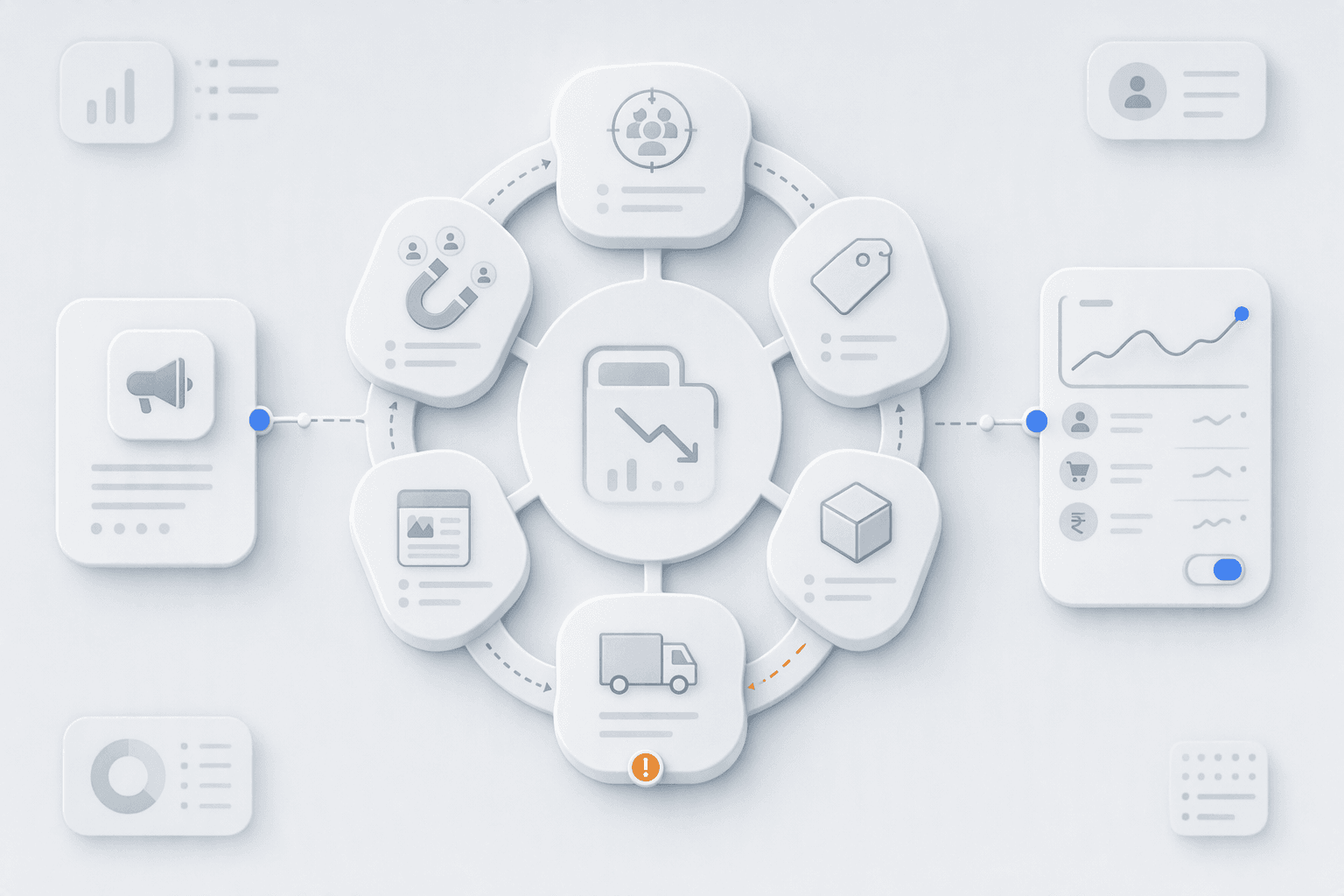
When revenue declines, check these in order.
1. Demand
Are fewer people interested in the category or product?
Look at traffic, search demand, product views and overall market behaviour.
2. Acquisition
Are your paid channels producing fewer qualified visitors?
Look at CAC, CTR, CPM and conversion quality.
3. Offer
Has the commercial proposition become less compelling?
Check price, discount, bundles, shipping and guarantees.
4. Conversion
Are visitors still purchasing at the same rate?
Check product pages, checkout, payment and mobile experience.
5. Product
Has the product itself become less competitive?
Look at reviews, returns, repeat purchase and customer feedback.
6. Operations
Can the business actually fulfil the demand?
Inventory, delivery delays, cancellations and RTO can quietly damage growth.
This diagnostic approach is much more useful than saying:
“Meta performance dropped, so let's change the campaign.”
How Can You Tell if Meta Is Actually the Problem?
Look for multiple signals moving together.
For example:
Likely acquisition problem
CPM rising
CTR falling
CPC rising
Conversion rate stable
Likely website/conversion problem
CTR stable
Traffic stable
Add-to-cart rate falling
Purchase conversion falling
Likely offer problem
Traffic stable
Product interest stable
Purchase rate declining
Competitor pricing becoming more aggressive
Likely product problem
Traffic stable
Conversion declining
Returns increasing
Reviews worsening
These aren't rigid rules.
They're starting points for investigation.
Arlox.io's Market Research & Analysis approach exists because advertising performance has to be interpreted in the context of the market, customer and commercial environment.
Why Founders Often Blame Meta First
Because Meta is visible.
You can open Ads Manager and immediately see:
Spend
Revenue
ROAS
CPM
CTR
Purchases
You can't see “customer confidence” as a single number.
You can't see “the offer stopped feeling compelling.”
You can't see “customers now think the competitor has a better value proposition.”
Those require investigation.
This is why experienced Meta advertising India teams should not behave like dashboard operators.
The job is not to react to every metric movement.
The job is to identify what changed and why.
What Should You Do Before Changing Your Campaign?
Create a simple weekly business diagnostic.
Track:
Revenue
Ad spend
Blended CAC
Meta CAC
AOV
Conversion rate
Contribution margin
New customers
Repeat customers
Return/RTO rate
Top SKU contribution
Then compare against the previous period.
Don't ask:
“What's the worst number?”
Ask:
“Which variable changed first?”
That is often where the real story begins.
Arlox.io's Meta Ads Scaling methodology is built around making scaling decisions from the broader system rather than reacting to isolated dashboard fluctuations.
If your D2C brand is experiencing a revenue decline and you're not sure whether the problem is Meta, the website, the offer or the business itself, book a strategy call with Arlox.io.
You can also explore Arlox.io, our Market Research & Analysis, and the Arlox.io blog for more D2C growth insights.
Written by -
Evyan Kumar is Head of Marketing & Brand Growth at Arlox.io — a scientific advertising agency helping D2C fashion brands scale profitably on Meta. Based in Gurugram, India.
Arlox is a performance marketing agency for D2C fashion brands, working on profitable scaling, RTO reduction, COD-to-prepaid conversion, and the CM1/CM2 repair that decides whether growth is worth having. 450+ brands worked with, with hundreds of on-camera founder interviews on record. Founded by Varinder Singh Gakhar (Vann Laniakea).