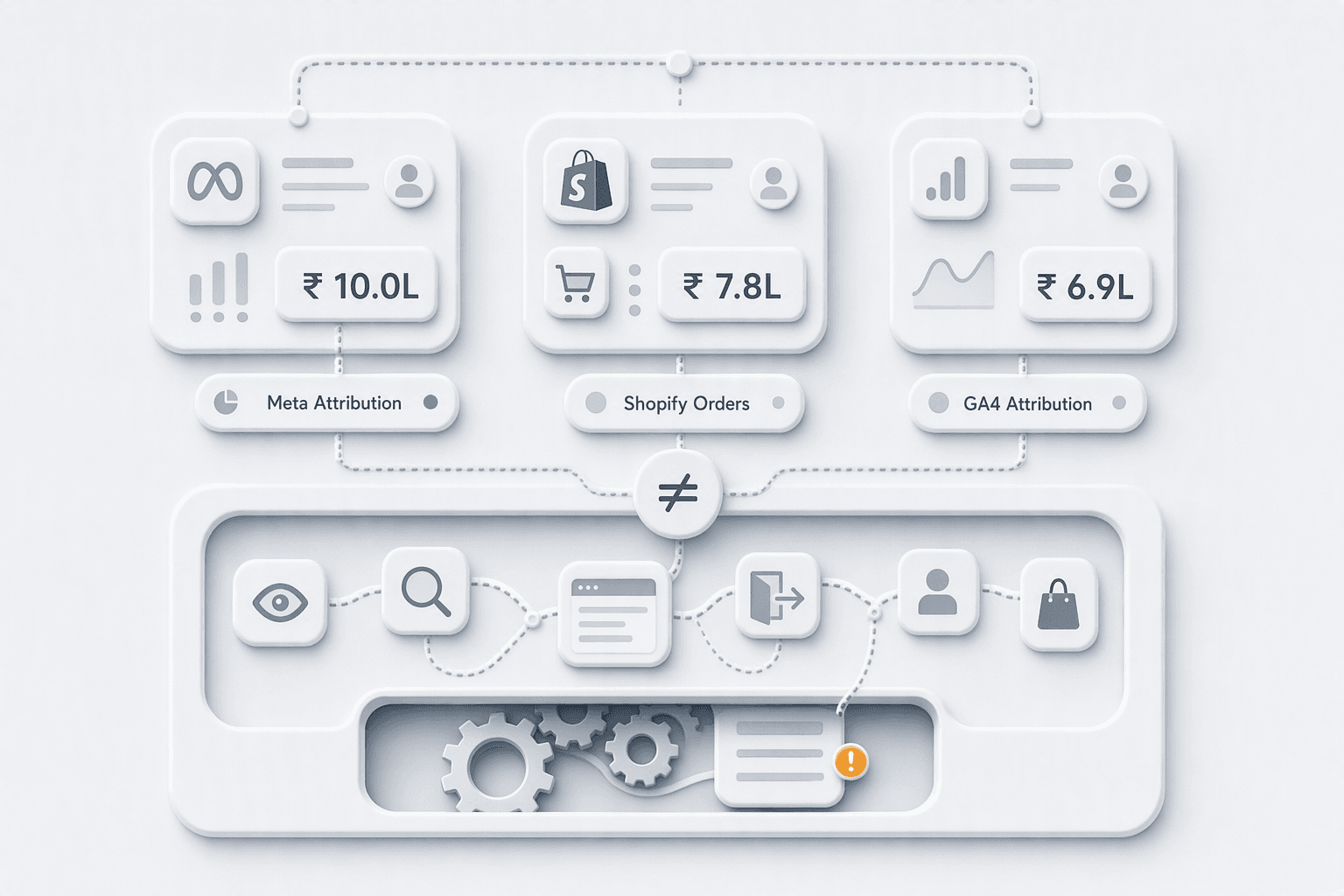
When Meta Ads and Shopify Show Different Revenue
You open Meta Ads Manager. You see ₹10 lakh in attributed revenue.
You open Shopify.
₹7.8 lakh.
You open GA4.
₹6.9 lakh.
Every D2C founder asks the same question:
“Which number is correct?”
The answer: none of them is the single source of truth.
The numbers differ because each platform assigns credit differently. For D2C fashion brands spending on Meta, understanding attribution is not an analytics exercise. It decides where your next ₹1 lakh of ad spend goes.
Why Meta Ads Revenue and Shopify Revenue Can Differ
Attribution is a decision about who gets credit for a purchase.
A customer might:
See your Instagram ad.
Ignore it.
Search your brand on Google two days later.
Visit your website.
Leave.
Return through direct traffic.
Purchase.
Which channel caused the purchase? There is no objective answer.
Meta assigns credit based on its ad interactions and attribution settings. Shopify uses a different approach. GA4 has its own models.
Google states that customers interact with multiple marketing touchpoints before converting, and attribution models determine how credit is distributed across those touchpoints. (Google Help)
Disagreement between platforms is not proof something is broken.
It means they are answering different questions.
This distinction matters when you move from ₹20,000/day to ₹1 lakh/day.
Should D2C Brands Trust Meta Ads Manager or Shopify?
Neither. Use them in isolation and you get half the picture.
Meta tells you how Meta is performing as an advertising system.
Shopify tells you what actually happened to orders and revenue in your store.
GA4 tells you how customers move across different acquisition channels and touchpoints.
Google's Analytics documentation states that GA4 supports data-driven attribution and last-click models, allowing marketers to compare how different approaches change channel credit. (Google Help)
Stop asking:
“Which dashboard is right?”
Ask:
“What decision am I trying to make?”
If you are evaluating a Meta creative, Meta-level data matters.
If you are calculating actual business revenue, your ecommerce backend matters.
If you are deciding how channels work together, cross-channel analytics matters.
What Should a D2C Founder Do When the Numbers Don't Match?
Start with three numbers.
1. Actual store revenue
How much revenue was recorded in Shopify or your ecommerce backend?
2. Total marketing spend
How much did you spend across Meta, Google, creators, affiliates and other acquisition channels?
3. Attributed performance by platform
What does each advertising platform claim it contributed?
Look for the direction, not perfect numerical agreement.
Meta says performance improved. Shopify revenue increased. CAC remained acceptable. Business economics improved. You have several independent signals pointing the same way.
Meta reports a 5X ROAS. Total store revenue is flat. Blended CAC is worsening. Stop. Investigate before increasing spend.
Shopify notes that attribution becomes more complicated as businesses add channels and touchpoints, and different platforms can legitimately report different views of the same customer journey. (Shopify)
This is why Arlox.io's approach to scientific advertising does not depend on one dashboard number.
The advertising platform tells us what the platform sees.
The store tells us what the business experienced.
The job is connecting the two.
What Is the Best Attribution Setup for D2C Fashion?
Use a consistent measurement framework. Stop trying to force every platform to report identical numbers.
For most D2C brands, the framework should include:
Meta Ads Manager
Shopify or ecommerce backend
GA4
UTM discipline
Blended CAC
Total marketing spend
Contribution margin
New-customer revenue
Repeat revenue
GA4 allows marketers to compare attribution models and examine how different models distribute credit across customer journeys. (Google Help)
The objective is not to make every dashboard agree.
The objective is to make better decisions despite the differences.
Arlox.io works with D2C fashion brands across India, the UK, the US and Nigeria. This matters because customers interact with multiple channels before purchasing.
If you are trying to scale Meta while your internal reports constantly disagree, our Meta Ads Scaling approach starts with understanding the measurement environment before making aggressive budget decisions.
If your Meta dashboard, Shopify and GA4 are telling three different stories, book a strategy call with Arlox.io.
You can also explore more D2C performance marketing insights on the Arlox.io blog.
Written by -
Evyan Kumar is Head of Marketing & Brand Growth at Arlox.io — a scientific advertising agency helping D2C fashion brands scale profitably on Meta. Based in Gurugram, India.