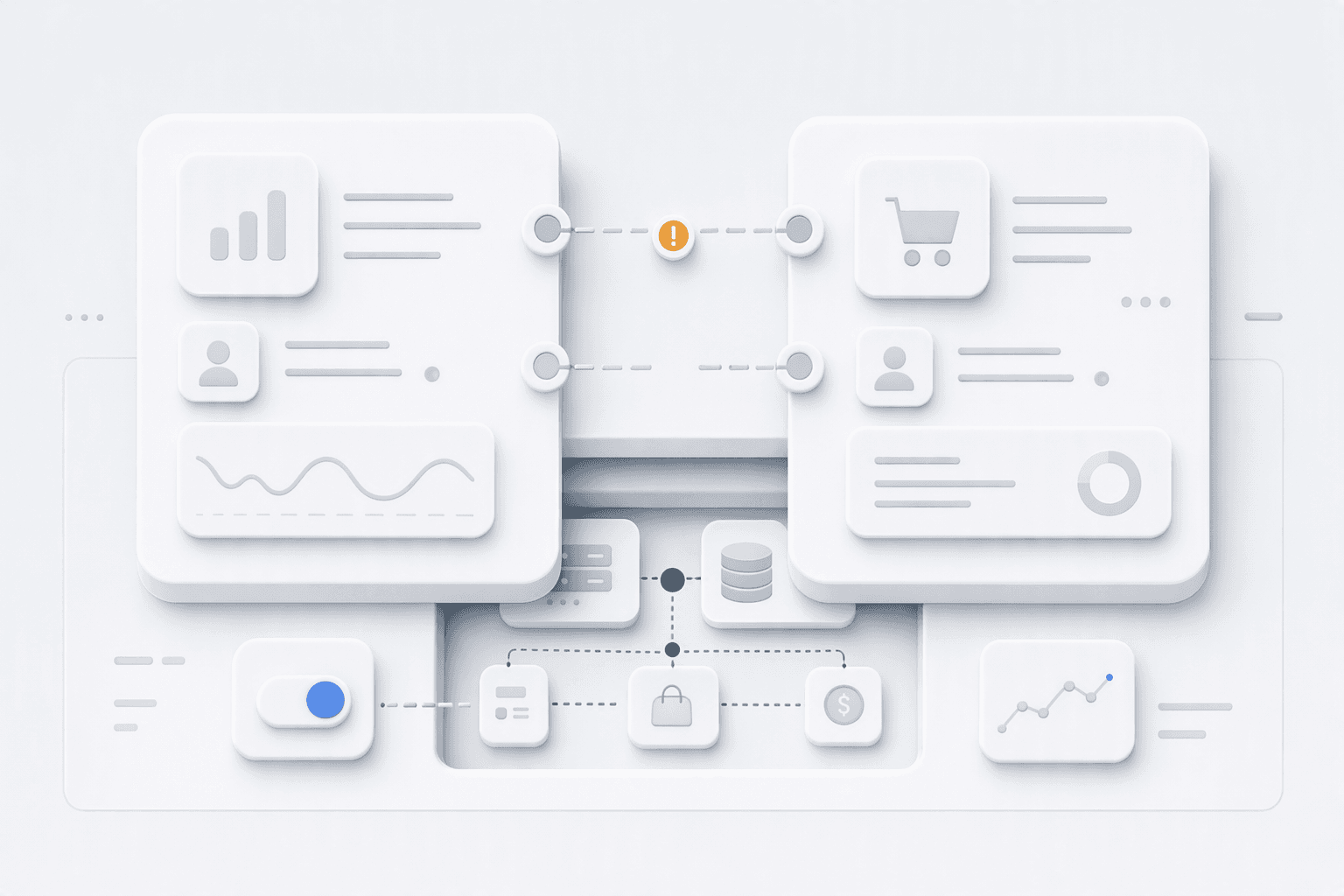
Arlox.io Review: We Blamed ROAS When the Data Was Wrong
The dashboard said the account was failing.
The founder saw the ROAS.
We saw the ROAS.
Everyone started debating how to fix it.
Then we found the real problem.
Our measurement system wasn't clean enough to support that decision.
What Actually Happened
The D2C brand had been running Meta ads for months.
Performance had gone inconsistent. Strong days. Terrible days. No pattern.
Blended ROAS sat below target.
The conversation followed the obvious path:
"What do we need to change in the campaigns?"
We checked creative performance. Then campaign structure. Then budget allocation. Then audience performance.
All normal places to look.
But something kept bothering us.
The purchase numbers inside Meta didn't line up with the brand's actual order data.
Not perfectly.
And "not perfectly" isn't good enough when you're deciding where to spend budget.
We dug deeper.
The tracking setup had inconsistencies. Some events weren't firing the way we expected. Attribution windows and platform-reported results were being read too literally.
The result: we had spent weeks optimizing the advertising system using a measurement system that wasn't giving us a complete picture.
That's a hard realization for a performance agency.
The worst mistake isn't running a bad campaign. It's making a confident decision from bad data.
Where We Got It Wrong
We should have audited the measurement layer earlier.
Instead, we treated the dashboard as the source of truth before validating how that dashboard was built.
That's on us.
Meta reporting is useful. But platform-reported attribution is not the same as a business's complete view of customer acquisition.
Google's measurement guidance makes a similar point: customer journeys can involve multiple touchpoints, and relying on a narrow attribution view can produce an incomplete picture of marketing impact. (Google)
For D2C brands, this matters most when founders compare:
Meta revenue
Shopify revenue
payment gateway data
cancelled orders
RTO
repeat purchases
blended marketing spend
Those numbers don't automatically reconcile into one clean metric.
The agency's job is not to pretend they do. The agency's job is to understand what each number means.
Our mistake was letting campaign-level ROAS dominate the conversation before establishing measurement confidence.
That led to another mistake.
We nearly changed a campaign that might not have been the real problem.
Cutting a profitable campaign because your reporting says it's inefficient isn't optimization. It's destroying an asset because the thermometer is broken.
What Changed at Arlox.io After This
Measurement became a prerequisite, not an afterthought.
During account onboarding and performance reviews, we got stricter about validating:
Purchase-event tracking.
Pixel and server-side signals where applicable.
Platform versus backend revenue.
Attribution differences.
Order cancellations.
Data discrepancies.
Reporting windows.
Blended account economics.
We also changed how performance conversations happen.
Instead of:
"ROAS is down. Fix it."
The question became:
"Which layer changed?"
Did traffic quality change?
Did conversion rate change?
Did AOV change?
Did the purchase event change?
Did attribution change?
Did creative efficiency change?
Did the economics of the product change?
Did spend increase faster than demand?
Each answer leads to a different action.
That's the core principle behind scientific media buying. Diagnosis before intervention.
Clean data matters because without it, every downstream decision is a guess. We've seen accounts plateau when the real bottleneck was tracking, not creative or audience targeting. Fix the measurement first, then fix the media. (Arlox.io)
Can you trust Meta ROAS completely?
No single platform metric should be treated as the entire financial truth of a D2C business. Meta ROAS is an important advertising metric, but it belongs alongside backend revenue and broader business economics, not above them.
Why can Meta and Shopify revenue differ?
Attribution rules, reporting windows, tracking configuration, cancellations, refunds, and customer journeys can all produce gaps between platform-reported and backend revenue.
Should a Meta ads agency optimize campaigns based only on ROAS?
No.
ROAS is useful for decision-making. But the agency should understand the underlying data and business economics before making major campaign changes.
What This Means for D2C Brand Owners
If you're reading an Arlox.io review, here's what I'd ask any agency before hiring them:
"Show me how you validate the numbers."
Not:
"Can you get me 5x ROAS?"
Anyone can promise a number. Very few teams can explain what happens when Meta says 4.8x and your backend says 3.9x.
The answer shouldn't be:
"Meta is always right."
It also shouldn't be:
"Shopify is always right."
The answer should be:
"Let's understand why they're different."
That's what mature D2C fashion performance marketing looks like.
Whether the brand is in India, the UAE or the US, measurement problems don't become less important as spend increases. They become more expensive.
If you're searching for "Arlox.io results", our case studies are public, not hidden behind a sales deck. You can review them on our case studies page. (Arlox.io)
And if you're evaluating us as a Meta ads agency India, don't just look at the wins. Look at whether we're willing to publish mistakes like this.
A performance team that can't admit when its measurement was wrong isn't a team I'd trust with a serious ad budget.
We got the diagnosis wrong. We fixed the measurement process. And now we ask the harder question before changing campaigns:
Are we sure the number we're optimizing is telling us the truth?
CTA: If your Meta reporting and actual business numbers don't line up, start with Arlox.io's Market Research & Analysis and book a strategy call.
Written by -
Evyan Kumar
Head of Marketing & Brand Growth at Arlox.io
Evyan Kumar is Head of Marketing & Brand Growth at Arlox.io — a scientific advertising agency helping D2C fashion brands scale profitably on Meta. Based in Gurugram, India.