
Stop Waiting for a Photoshoot to Add AI Try-On to Your Shopify Store
One of the biggest objections fashion brands have to AI virtual try-on is not whether customers will use it. It is the work required to make it available across a real ecommerce catalogue.
Hundreds of SKUs. Multiple colours. New drops every month. Different variants. Constant product launches.
That is why the interesting question is not just “Can AI show this product on a customer?”
It is:
“Can I do this across my Shopify catalogue without rebuilding my entire content operation?”
For Style Me, that is a core part of the product architecture.
You Already Have Most of the Product Data Style Me Needs
A fashion brand already has product assets sitting inside Shopify.
Product images.
Variant images.
Product names.
Colour variants.
Product IDs.
Collection information.
The challenge is turning those existing assets into a personalised shopping experience.
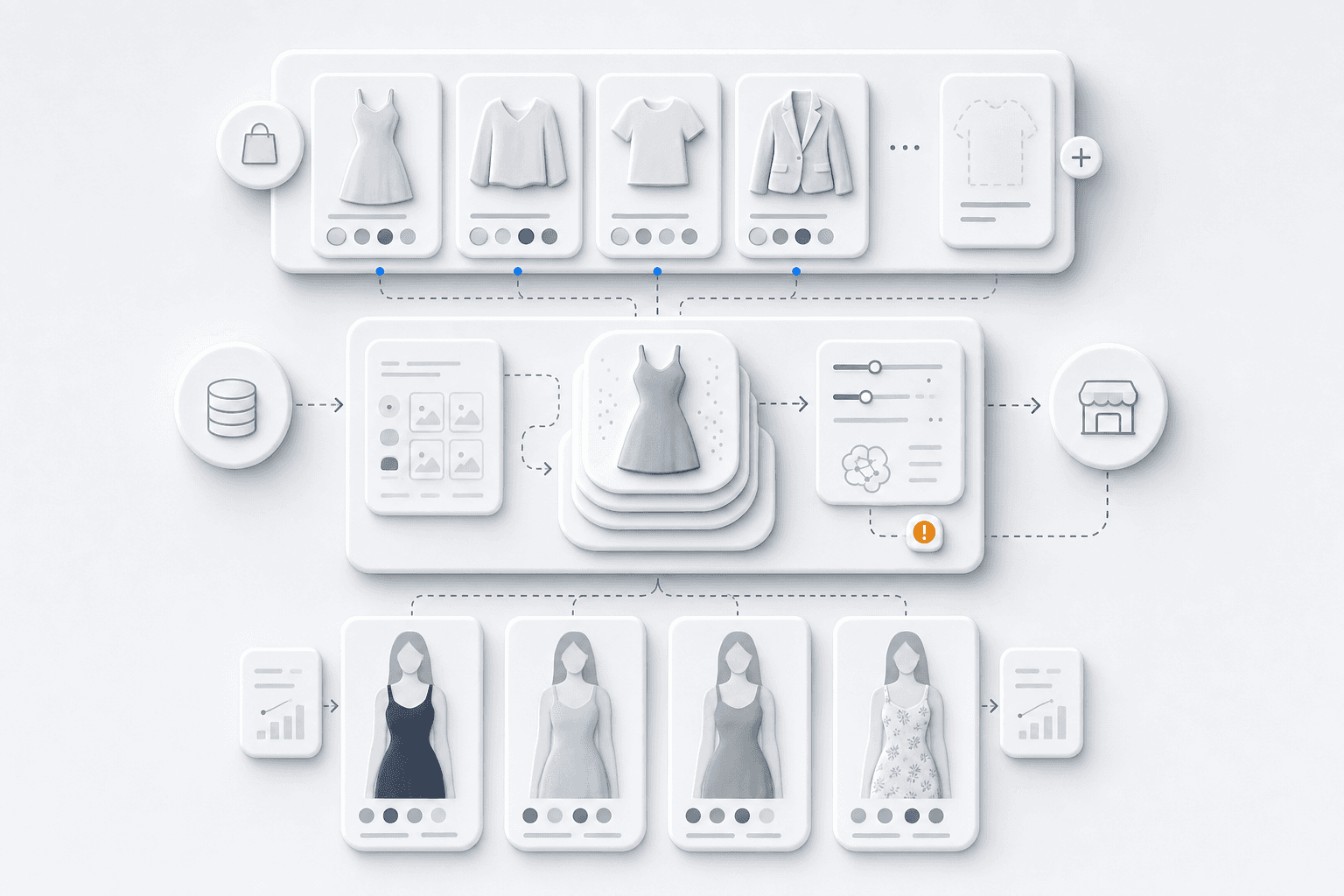
Style Me's technical documentation states that its Shopify integration automatically crawls the store's product graph to identify clothing items and uses the merchant's variant imagery as the high-resolution ground truth for the synthesis process. (styleme.arlox.io)
That changes the implementation conversation.
You are not necessarily starting with:
“We need to photograph every product on a special virtual model.”
You can start with:
“Can our existing product catalogue become the input for a personalised try-on experience?”
For a D2C fashion brand launching products continuously, that distinction matters.
How Does Style Me Work With Existing Shopify Products?
Answer: Style Me is built as a native Shopify Theme App Extension. Its documentation says the engine discovers clothing items from the store's product graph and uses variant imagery as the source reference for generating the virtual try-on experience. (styleme.arlox.io)
The technical setup is therefore tied to the store's existing product structure.
This is important because Shopify merchants already think in terms of:
Products → variants → product pages → customers.
Style Me fits into that architecture rather than requiring the merchant to create an entirely separate catalogue.
Its documentation explains that the Style Me blocks can be enabled through Shopify's Theme Editor and that the button can be placed directly within the product-page blocks. (styleme.arlox.io)
For a founder, this means the implementation can be approached as a storefront upgrade, not a new technology project.
That is a much easier operational decision.
Why Catalogue Scale Is the Real Test for Fashion AI
A demo with one beautiful dress is easy.
A live ecommerce business is not.
Imagine a fashion brand with:
300 products
12 colours
5 sizes
2 seasonal collections
New products launching every week
The real question is whether the technology can fit into that operating model.
That is where automation matters.
If every new product requires a separate manual AI workflow, the feature becomes difficult to maintain.
If the system can discover products from the Shopify catalogue and use existing variant assets as inputs, the operational burden can be much lower. Style Me's technical documentation specifically describes this automatic catalog-discovery process. (styleme.arlox.io)
This is particularly relevant for Indian D2C fashion brands where product catalogues can change rapidly around festive drops, wedding seasons, collection launches and trend cycles.
The same applies to brands expanding into the UAE, UK and US.
The catalogue keeps moving.
The customer experience needs to keep up.
Does Every SKU Need a New Photoshoot?
Answer: Not necessarily.
That is one of the more useful implications of the Style Me architecture.
The product does not describe a requirement for merchants to create a dedicated photoshoot for every product before enabling virtual try-on. Instead, its documentation states that the system uses existing variant imagery from the Shopify product catalogue as the high-resolution ground truth for synthesis. (styleme.arlox.io)
That does not mean product photography stops mattering.
It means your existing product photography can potentially do more work.
A good product image already contains valuable information:
Shape
Colour
Construction
Pattern
Silhouette
Product detail
Those assets are already being used to sell the product.
Style Me adds another application for that same product information:
Personalised visualisation.
That's a much more efficient way to think about ecommerce technology.
Don't ask:
“What new content do we need to create?”
Ask:
“What more can we do with the content and product data we already have?”
Why Variant Handling Matters More Than Founders Think
Fashion ecommerce isn't one-product ecommerce.
A single product can have multiple colours, patterns or variants.
If the customer selects black, they don't want to see a try-on of the beige version.
That sounds obvious.
But technically, variant-level product information matters.
Style Me's documentation shows that its storefront integration includes product and variant identifiers, and that variant imagery is used as the visual source for synthesis. (styleme.arlox.io)
That is important for merchants because the customer experience needs to stay aligned with what is actually being purchased.
A virtual try-on should not become another place where the customer gets confused.
The product selected should be the product visualised.
The colour selected should make sense.
The experience should support the purchase rather than create another mismatch between expectation and reality.
How Fast Can a Brand Add Style Me?
Style Me currently describes a native Shopify implementation with Theme App Extension support and says setup can take less than two minutes. Its main product site also describes automatic theme injection, mobile-first responsiveness and a native-feeling product-page experience. (styleme.arlox.io)
That matters because the biggest obstacle to ecommerce experimentation is often not the idea.
It's the implementation time.
A founder might love the concept of virtual try-on but think:
“We'll revisit this when we redesign the store.”
That's often how useful improvements get delayed for six months.
A lightweight integration makes testing much easier.
Instead of asking whether the technology is worth rebuilding the site around, the merchant can ask whether it is worth testing as a product-page layer.
That's a much smaller decision.
Should You Add Style Me to Every Product Immediately?
Answer: You don't need to treat the entire catalogue as one test.
Start where the commercial opportunity is strongest.
For example:
Top-selling products
These already receive significant traffic.
High-return products
These may have a meaningful expectation or fit problem.
High-consideration products
Higher prices can create more hesitation before purchase.
Hero products
These are often responsible for a large share of acquisition revenue.
Products with strong Meta traffic
These already have paid demand flowing to the PDP.
This is where scientific advertising becomes relevant outside the ad account.
You don't need to launch a technology everywhere and hope.
Build a hypothesis.
For example:
Customers are not converting because they cannot visualise the fit on themselves.
Then test Style Me on selected products.
Measure:
Feature usage
Add-to-cart rate
Conversion rate
Revenue per visitor
Return rate
AOV
Now the question becomes empirical.
Not:
“Does AI try-on look cool?”
But:
“Did this improve the economics of the product page?”
Can Style Me Work Alongside Existing Fashion Content?
Yes.
And it probably should.
Your product page might already have:
Studio photography
for clarity.
Lifestyle photography
for context.
UGC
for social proof.
Reviews
for credibility.
Size information
for fit guidance.
Style Me adds another layer:
Personal visualisation.
That makes it complementary rather than a replacement.
Shopify's own guidance around product-page optimisation recommends using rich visual media and interactive experiences to help customers understand products before purchasing. (shopify.com)
The strongest product pages therefore don't rely on one asset.
They build a chain of confidence.
Where Style Me Fits Into Paid Acquisition
This is where the tool becomes especially relevant for Arlox.
A Meta campaign creates the initial demand.
A customer clicks.
They land on a product page.
Now your acquisition spend depends on what happens there.
If they don't understand the product, you have a content problem.
If they don't trust the brand, you have a trust problem.
If they don't know their size, you have a fit-information problem.
If they can't imagine themselves wearing the product, you have a visualisation problem.
And if you are sending increasingly expensive traffic into that environment, the value of solving those problems increases.
That's why Arlox doesn't look at Meta advertising India purely as a media-buying exercise.
Acquisition and conversion have to connect.
The Meta Ads Scaling side brings qualified traffic.
The CRO Toolkit helps diagnose what happens after the click.
And Style Me addresses one specific fashion ecommerce problem: helping the shopper visualise the garment on themselves.
Three different jobs.
One customer journey.
What Happens When a New Product Launches?
This is perhaps where the model becomes most useful operationally.
Imagine a Shopify fashion brand launches a new collection.
Normally:
Product uploaded.
Images uploaded.
Copy written.
Variants configured.
Collection updated.
Ads launched.
With a catalogue-integrated virtual try-on layer, the merchant can potentially make the new product part of the same personalised experience without creating a completely separate asset workflow.
Style Me's documentation says its engine automatically discovers clothing items in the product graph and uses variant imagery as the source reference. (styleme.arlox.io)
That means the technology is built around the way Shopify merchants already operate.
The catalogue remains the source.
The product page remains the destination.
The AI becomes another layer on top.
That's a much more scalable model than treating every product as a one-off AI project.
The Bigger Point: AI Should Remove Work, Not Create More of It
This is the standard worth applying to every new ecommerce technology.
Don't ask:
Is it AI?
Ask:
Does it improve the customer's experience?
Does it improve conversion?
Does it reduce uncertainty?
Does it fit our existing workflow?
Can our team actually operate it at scale?
For fashion brands, technology becomes much more useful when it works with the systems they already have.
That's what makes Style Me's Shopify-native architecture interesting.
The product catalogue remains the foundation.
The existing variant imagery remains valuable.
And the personalised experience gets added directly where the customer is already making the decision.
CTA
See how Style Me works with a Shopify fashion catalogue, or book a strategy call with Arlox.io to discuss where virtual try-on could fit into your acquisition and conversion system.
AUTHOR BIO
Evyan Kumar is Head of Marketing & Brand Growth at Arlox.io — a scientific advertising agency helping D2C fashion brands scale profitably on Meta. Based in Gurugram, India.