Arlox.io Results: We Changed Too Many Things at Once
ROAS dropped.
We panicked.
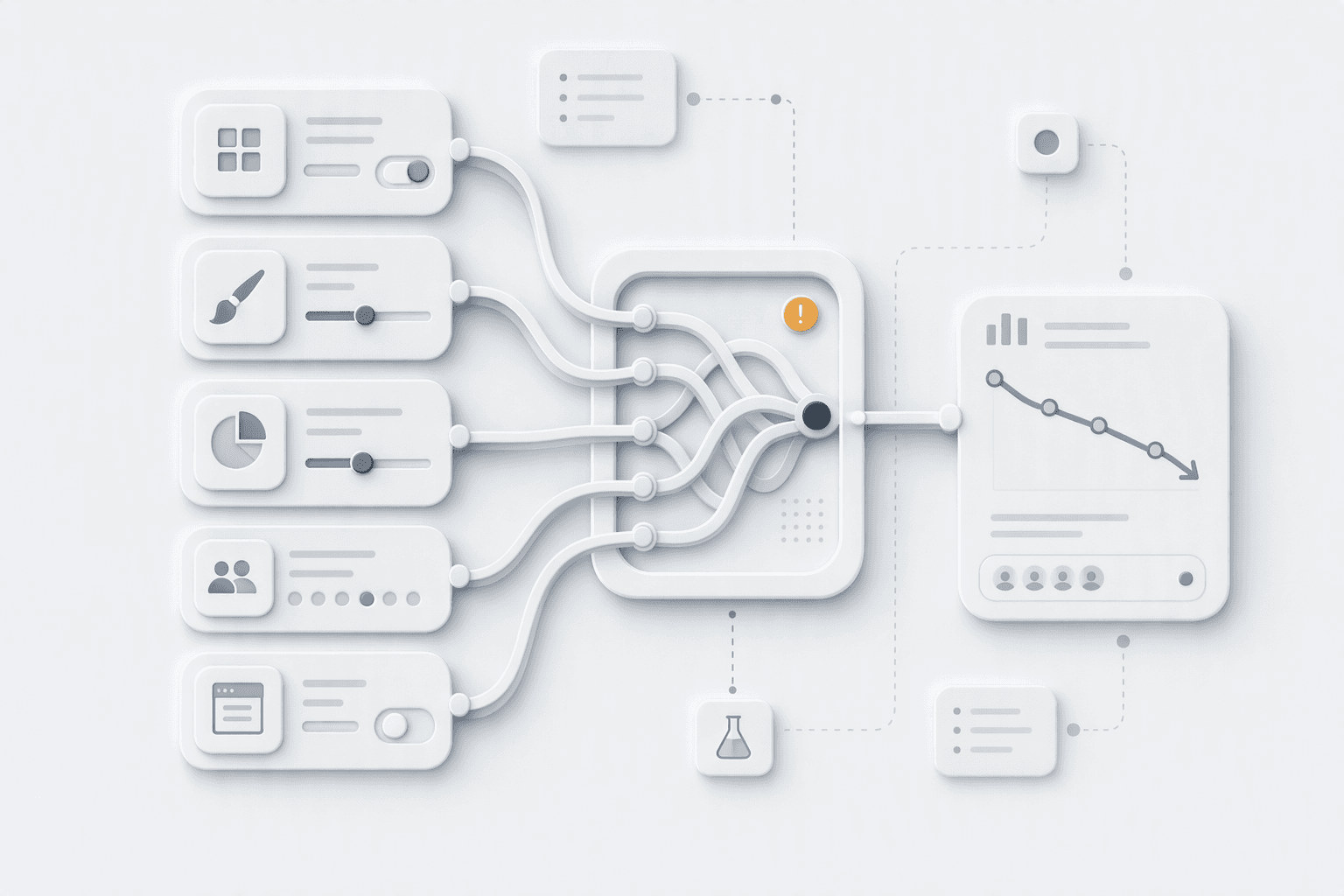
Then we changed the campaign structure, creative allocation, and budget at roughly the same time.
A week later, performance was still bad.
And we had one problem:
We couldn't tell why.
What Actually Happened
The account had been stable.
Not spectacular.
Stable.
Then performance started weakening.
The founder wanted an explanation.
Fair.
We started investigating.
The first hypothesis was creative fatigue.
So we introduced new ads.
Then we thought the campaign structure was limiting delivery.
So we changed that too.
Then budget allocation looked inefficient.
So we moved spend.
Then another campaign showed a promising result.
We shifted more budget there.
Individually, every decision had logic.
Collectively, we had created chaos.
We changed too many variables in too short a period.
The next week's data was basically useless.
If performance improved, we wouldn't know what caused it.
If performance got worse, we wouldn't know what caused that either.
We had turned the account into a laboratory where someone changed the experiment, the control group, and the measuring instrument at the same time.
That's not scientific.
That's guessing with a dashboard.
Where We Got It Wrong
Our biggest mistake was breaking the feedback loop.
A good testing system creates learning.
Hypothesis.
Test.
Measure.
Interpret.
Next hypothesis.
Instead, we did:
Problem.
Change everything.
Wait.
Hope.
That is a terrible operating system for paid media.
It also creates a psychological trap.
When you change five things at once and performance improves, everyone wants to claim the win.
When performance falls, everyone blames Meta.
Neither conclusion is necessarily justified.
The deeper problem was our decision velocity.
We were moving fast without keeping enough experimental discipline.
This is especially dangerous in D2C fashion because the account has many moving pieces.
A new product.
A new offer.
A new creative.
A seasonal shift.
A budget change.
A landing-page change.
A new audience.
If all of them happen together, attribution becomes harder.
The account may look busy.
But the team may be learning nothing.
What Changed at Arlox.io After This
We tightened our testing architecture.
Every significant test now needs:
A hypothesis.
A variable.
A success criterion.
A failure criterion.
A next action.
That sounds obvious.
It wasn't always how we operated.
We also became much stricter about separating exploratory testing from scaling decisions.
If we're testing a new angle, the objective is learning.
If we're scaling a proven angle, the objective is controlled expansion.
Mixing those two creates confusion.
This thinking is reflected in our Scientific Angle Testing framework, where creative testing is organized into strategic angles, hook categories, and executional variations. (Arlox.io)
It gives us a way to say:
"This failed because the angle didn't resonate."
instead of:
"This ad didn't work."
That difference matters.
The second statement tells you almost nothing.
The first tells you what to test next.
We also introduced stronger post-test documentation.
If an angle fails, we record why.
If a hook works, we record what appears to have made it work.
If a campaign wins, we don't immediately declare victory.
We ask what evidence supports the win.
Why is changing too many Meta ad variables dangerous?
You lose the ability to identify which change affected performance. Multiple simultaneous changes make campaign results harder to interpret and reduce the quality of future decisions.
Should a Meta ads agency test everything simultaneously?
Not necessarily.
Testing needs enough variation to discover opportunities but enough control to produce useful learning.
What does scientific testing mean in Meta advertising?
It means treating advertising decisions as hypotheses that can be tested, measured, and iterated rather than making random creative or campaign changes without a defined learning objective.
What This Means for D2C Brand Owners
If you're evaluating Arlox.io.io results, don't just ask how many campaigns we launched.
Ask:
"What did you learn from them?"
Campaign volume is not the same thing as learning velocity.
A team can launch 50 ads and learn almost nothing.
Another team can test 10 carefully structured hypotheses and discover the strongest customer trigger in the account.
That's the difference between activity and progress.
It's also why I don't believe every Meta ads problem can be solved by "more creatives."
Sometimes you need more creative.
Sometimes you need a new angle.
Sometimes you need better measurement.
Sometimes you need to stop scaling.
Sometimes you need to stop a campaign.
Sometimes the data is telling you that the offer itself isn't competitive.
But you can't know which one it is if you keep changing everything simultaneously.
That lesson has influenced how we approach Meta advertising fashion brands India, as well as accounts in the UAE and US.
The market changes.
The account changes.
The customer changes.
The testing system has to keep producing learning.
Our published case studies show outcomes, but the more important thing behind those outcomes is the decision system that produced them. (Arlox.io)
And that's the honest part of this Arlox.io review:
We once moved too many pieces at once.
The result wasn't just a bad week.
It was a loss of information.
We couldn't clearly tell what worked.
So we changed the process.
In performance marketing, bad performance is painful.
But bad learning is worse.
CTA: If your agency is making multiple Meta changes every time ROAS drops, explore Arlox.io's Scientific Angle Testing or book a strategy call.
Written by -
Evyan Kumar
Head of Marketing & Brand Growth at Arlox.io.io
Evyan Kumar is Head of Marketing & Brand Growth at Arlox.io.io — a scientific advertising agency helping D2C fashion brands scale profitably on Meta. Based in Gurugram, India.