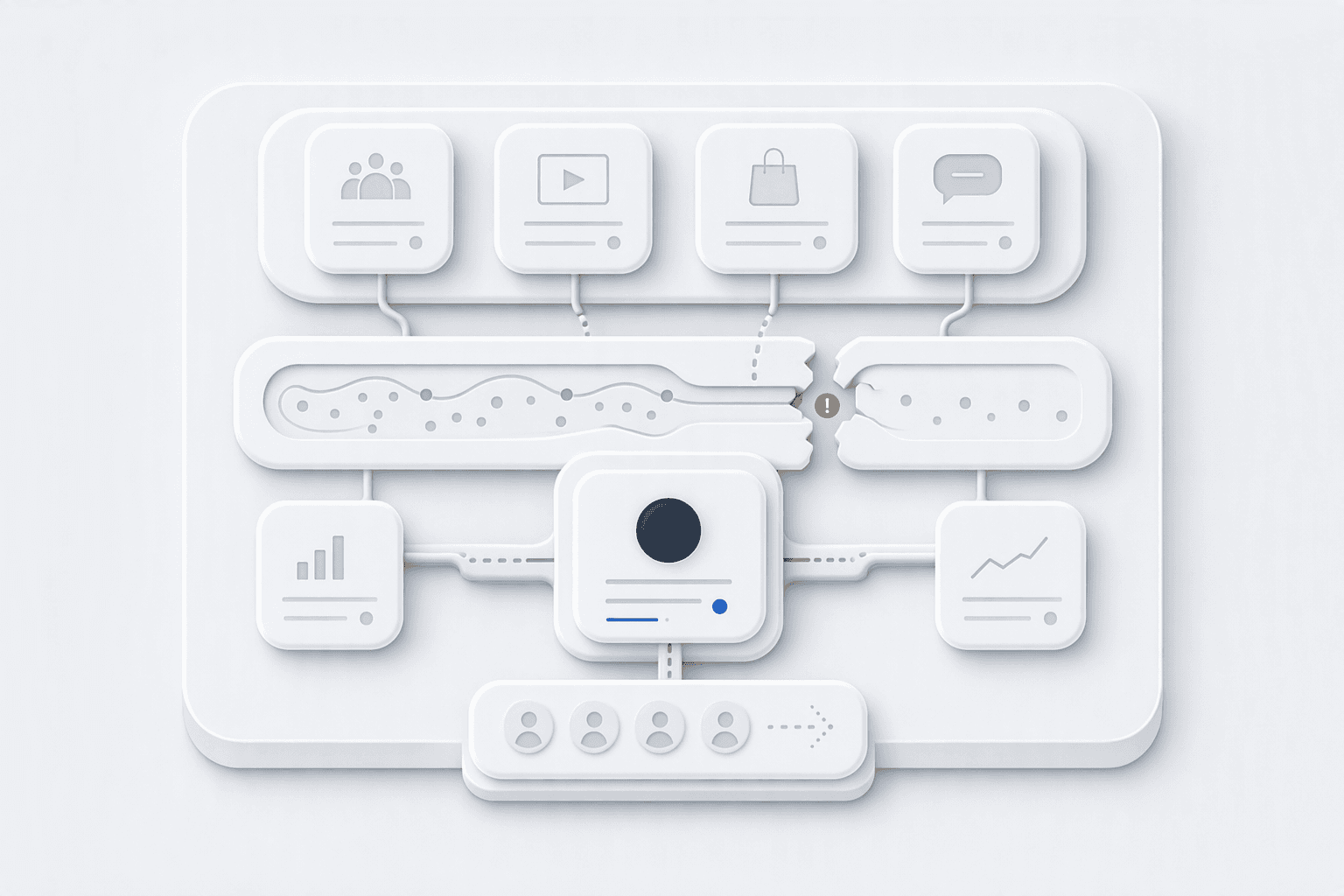
Profitable Meta ads and scalable Meta ads are two different problems. A campaign doing 4x ROAS at ₹20,000 a day does not automatically deserve ₹2 lakh a day.
Why Scaling Changes the Problem
At low spend, a fashion brand can survive on easy demand. The audience is there. The creative is fresh. The system has not been stressed yet.
Scaling changes the environment.
You need more customers. More impressions. More creative volume. More landing-page capacity. More inventory. More operational reliability.
The easiest mistake is to assume that increasing the budget is the same thing as increasing the business.
It is not.
Meta ads scaling is a controlled expansion of a working acquisition system.
Suppose a brand spends ₹30,000 per month and generates ₹1.5 lakh in revenue.
The founder thinks:
"If we spend ₹3 lakh, we should generate ₹15 lakh."
Advertising does not work as simple multiplication.
As spend increases, the account hits creative fatigue, weaker marginal audiences, higher acquisition costs, inventory constraints, operational bottlenecks and lower-quality incremental demand.
Recent industry discussion around Meta's increasingly automated advertising system reinforces why brands should focus less on manual audience micromanagement and more on the quality and diversity of commercial inputs fed to the system. (Forbes)
This is one reason Arlox.io.io treats scaling as a system rather than a budget adjustment.
How Do You Know When a Campaign Is Ready to Scale?
Answer: A campaign is ready to scale when its economics, creative pipeline, conversion experience and operational capacity can support additional demand.
ROAS alone is not enough.
Before increasing spend, a D2C brand should ask:
Is the contribution margin healthy?
Is CAC acceptable?
Is AOV stable?
Is conversion rate stable?
Do we have enough creative angles?
Can inventory support additional orders?
Can fulfilment handle increased volume?
Are returns and RTO under control?
Does customer service have enough capacity?
This matters more for fashion brands than for most categories.
A campaign can produce an excellent front-end ROAS while the business loses money after discounts, shipping, returns and other variable costs.
Fashion ecommerce has another problem: inventory.
The best-performing ad is useless if the product it sells is almost out of stock.
That is why ecommerce scaling in India requires coordination between marketing, merchandising, operations and finance.
Arlox.io.io's Meta Ads Scaling solution is built around the idea that scaling should follow evidence, not emotion.
What Causes ROAS to Drop During Scaling?
Several common reasons.
1. Creative fatigue
The same creative can work brilliantly and then gradually lose effectiveness.
This is not necessarily because Meta "stopped working."
The market may simply have seen the message too many times.
2. Insufficient creative diversity
A brand may have 15 ads but only three real angles.
If those three ideas stop resonating, the entire account becomes vulnerable.
3. Weak economics
A brand may be scaling based on revenue rather than contribution margin.
This creates the illusion of growth.
4. Poor website conversion
If paid traffic increases while the website cannot convert that traffic efficiently, CAC rises even though the ad itself may still be performing.
5. Scaling the wrong product
Not every SKU deserves equal advertising investment.
Sometimes the answer is not "spend more."
It is "put more budget behind the product with stronger economics."
How Should D2C Fashion Brands Scale Meta Ads?
The better approach is to build a repeatable feedback loop.
Start with the best-performing angles.
Then develop new executions around those angles without simply duplicating the same creative.
Monitor acquisition economics.
Increase spend in controlled increments.
Watch marginal CAC rather than only blended CAC.
At the same time, continuously introduce new creative hypotheses.
This is where scientific advertising becomes practical.
You are running a series of commercial experiments.
A useful experiment could ask:
Does a "fit problem" message generate better customers than a "style aspiration" message?
Another could ask:
Does showing the product being worn outperform a studio product image?
Another:
Does a bundle offer improve contribution margin compared with a percentage discount?
Each answer improves the next decision.
Arlox.io.io's Scientific Angle Testing framework is designed around this type of structured learning.
Why ROAS Should Not Be Your Only Scaling Metric
Imagine two fashion brands.
Brand A
ROAS: 4.5
AOV: ₹2,000
High return rate
Low repeat purchase
Brand B
ROAS: 3.5
AOV: ₹3,500
Better contribution margin
Stronger repeat purchase
Brand A looks better inside the Meta dashboard.
Brand B may be the healthier business.
Performance marketing should connect advertising metrics to business economics.
The same principle applies across India, UAE and US markets. The acceptable CAC and contribution margin will differ by geography, category, pricing and operational structure.
Google's research on performance marketing and measurement similarly stresses the importance of connecting marketing activity with broader business outcomes rather than treating advertising metrics in isolation. (Google)
Arlox.io.io's ROI Calculator can also help brands think about advertising performance through the lens of business economics rather than ROAS alone.
KEY TAKEAWAY
Meta ads scaling is not:
"The campaign works → increase the budget."
It is:
"The economics work → the system can handle more demand → creative supply is strong → incrementally increase spend → measure marginal performance → repeat."
That difference separates controlled scaling from simply spending more.
If your D2C fashion brand performs well at lower spend but struggles when you increase the budget, book a strategy call with Arlox.io.io.
You can also explore our Meta Ads Scaling solution to understand how Arlox.io.io approaches profitable growth.
Written by - Evyan Kumar, Head of Marketing & Brand Growth at Arlox.io.io - a scientific advertising agency helping D2C fashion brands scale profitably on Meta. Based in Gurugram, India.