Is Arlox.io Good? We Kept a Bad Campaign Alive Too Long
The campaign wasn't working.
We knew it.
The client knew it.
We kept it running longer than we should have.
That isn't a theoretical mistake. That's wasted spend.
What Actually Happened
A D2C fashion brand came in with a campaign structure that had been running long enough to produce a reasonable amount of data.
The performance wasn't catastrophic.
That's what made the decision hard.
It wasn't a complete failure.
It was mediocre.
ROAS sat below the brand's target.
CPA was drifting.
The campaign still generated purchases.
Every few days it produced a decent result.
That created hesitation.
Maybe it would recover.
Maybe the next creative would work.
Maybe the algorithm would stabilize.
Maybe we just needed another week.
That "maybe" cost money.
The client eventually asked:
"Why are we still funding something that isn't hitting the target?"
We didn't have a strong enough answer.
The truth: we had become too attached to the possibility of recovery.
We were looking at individual positive signals instead of the total opportunity cost.
That was the mistake.
Where We Got It Wrong
We didn't kill the campaign because it wasn't obviously terrible.
That's exactly the problem.
Performance teams know how to identify disasters.
The harder skill is identifying mediocre spend.
A campaign producing occasional purchases can look alive.
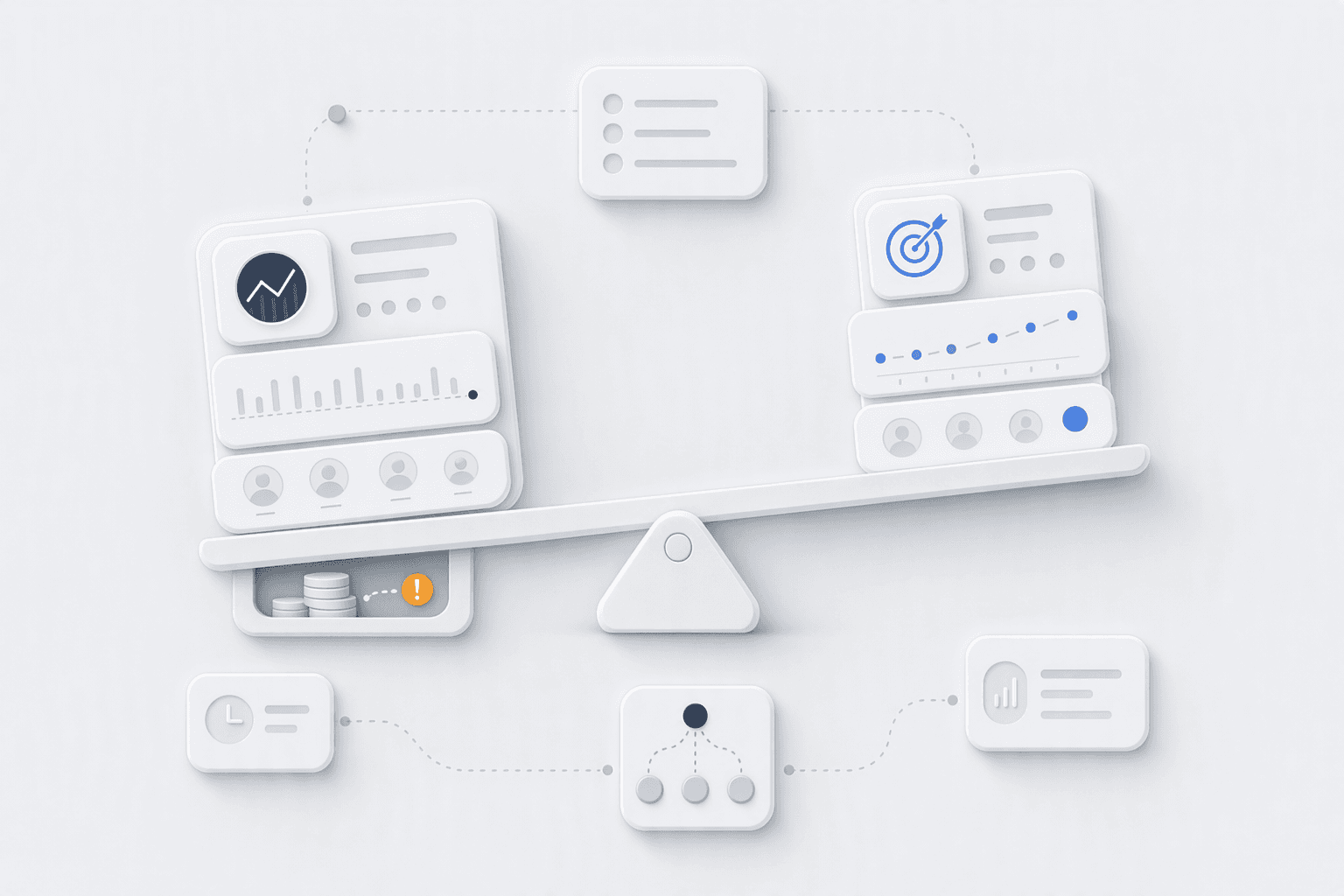
But if another campaign or creative has a materially stronger probability of producing profitable incremental revenue, keeping the weaker one alive has a cost.
That money could be funding a better hypothesis.
Our decision framework wasn't aggressive enough.
We were asking:
"Can this campaign still work?"
We should have asked:
"Is this currently one of the best uses of the next ₹10,000?"
That's a different question.
Meta advertising isn't about preserving every campaign you've built.
It's about allocating capital toward the strongest opportunities available.
This became obvious when we compared the campaign against newer creative angles.
The older campaign had history.
The newer tests had less history but stronger early signals.
We were letting the old campaign's familiarity outweigh the evidence.
That's backwards.
What Changed at Arlox.io After This
We introduced a clearer distinction between:
Keep
Test
Scale
Kill
A campaign doesn't earn permanent budget because it once worked.
It has to continue earning its place.
We also stopped evaluating campaigns in isolation.
A 2.8x ROAS campaign might be acceptable in one account.
It might be terrible in another.
The decision depends on:
Gross margin.
AOV.
CAC.
Repeat purchase economics.
Target contribution margin.
Current account performance.
Available alternatives.
Scaling objectives.
The benchmark isn't a universal internet ROAS number.
It's the business's economics.
That is why our Meta Ads Scaling approach is built around decision-making rather than simply keeping campaigns active.
We also added more structured test reviews.
A test should have a reason to exist.
When the evidence says the hypothesis isn't working, the team should be comfortable killing it.
Fast.
That's not failure.
That's the point of testing.
When should a Meta ad campaign be paused?
A campaign should be considered for pausing when its performance sits consistently below the account's economic target and there is stronger evidence that the budget could produce better returns elsewhere.
Is a low-ROAS campaign always a bad campaign?
No.
ROAS needs to be read against product margins, AOV, CAC, retention and the brand's growth objectives. A lower ROAS can be acceptable if the broader economics support it.
Why do agencies keep underperforming Meta campaigns running?
Sometimes because the campaign still produces some conversions, because there isn't a better alternative yet, or because teams become reluctant to abandon historical data. The correct decision should be based on opportunity cost and evidence.
What This Means for D2C Brand Owners
This is one of the biggest questions to ask when comparing a performance marketing agency in Gurugram or any other Meta ads partner:
"What makes you kill a campaign?"
The answer tells you a lot.
If the agency says:
"We optimize everything."
That's vague.
If they say:
"We don't like to turn campaigns off because the algorithm needs data."
Ask what data.
How much.
For what hypothesis.
Against what benchmark.
Because "give it more time" can sometimes be a valid media-buying decision.
And sometimes it is just an excuse for not making a decision.
There is another uncomfortable truth.
Founders make this mistake too.
You fall in love with a campaign because it once produced a great month.
You remember the 7x ROAS week.
You forget the four weeks around it.
Your agency does the same thing.
Suddenly everyone is protecting historical performance instead of building future performance.
The answer is not ruthless account destruction.
It is disciplined capital allocation.
So, is Arlox.io good?
That's not for me to answer with a sales line.
Review the work.
Look at the Arlox.io client case studies. (Arlox.io)
Then ask the more important question:
Does the agency know when to stop spending?
Because knowing how to launch campaigns is table stakes.
Knowing when to stop funding the wrong one is where accountability starts.
CTA: If your account has campaigns that have been running for months without a clear reason, review Arlox.io's Meta Ads Scaling approach or book a strategy call.
Written by -
Evyan Kumar
Head of Marketing & Brand Growth at Arlox.io.io
Evyan Kumar is Head of Marketing & Brand Growth at Arlox.io.io — a scientific advertising agency helping D2C fashion brands scale profitably on Meta. Based in Gurugram, India.