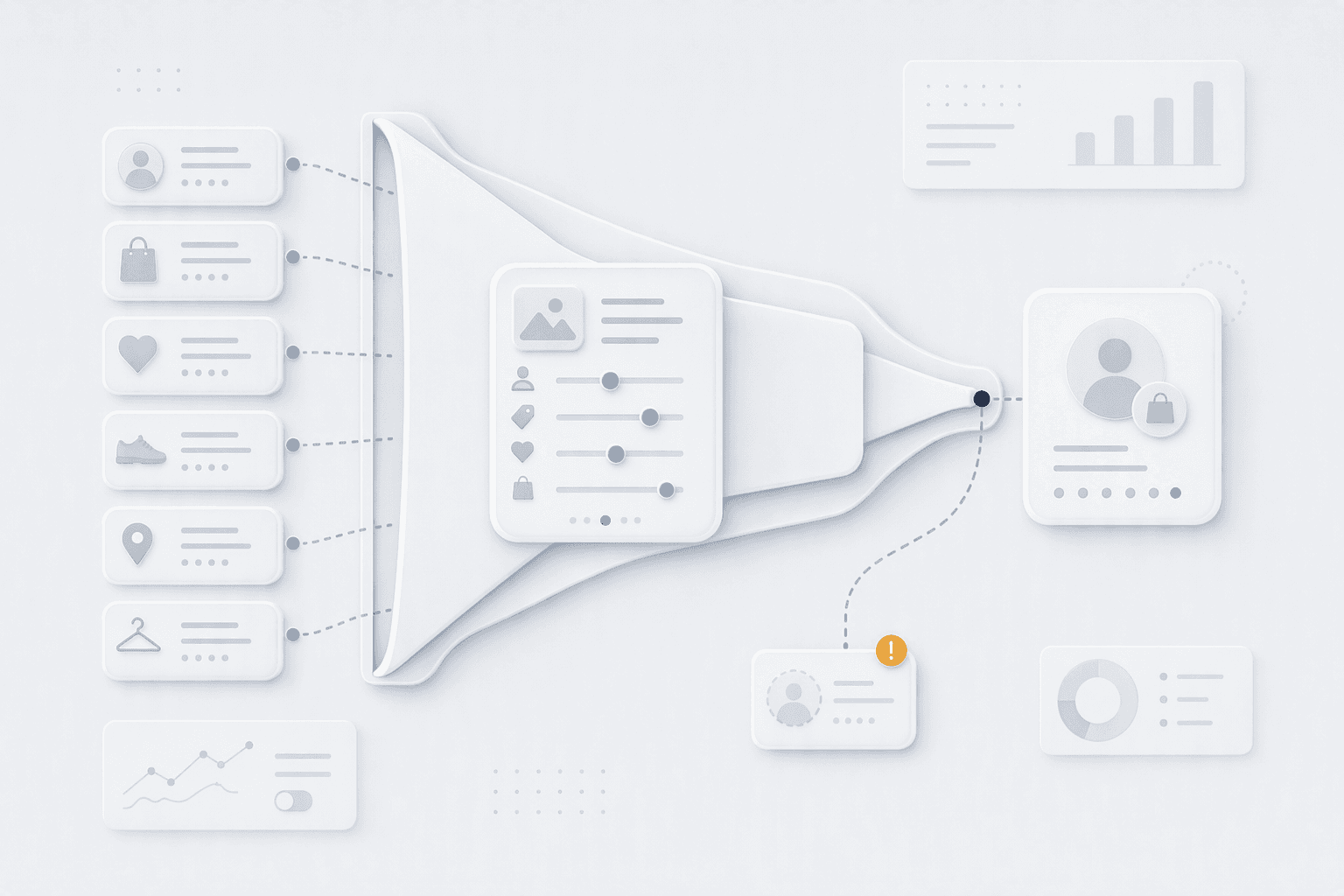
Meta's automation has changed how fashion brands target on its platform. The question is no longer how many interests to stack. The question is whether your creative and conversion data give Meta enough signal to find buyers.
Why Manual Targeting Is Losing Its Old Advantage
For years, fashion brands ran Facebook ads the same way.
Choose an age group.
Add fashion interests.
Add competitor interests.
Layer behaviours.
Exclude audiences.
Create lookalikes.
Build multiple ad sets.
It felt precise. Precision in the interface does not guarantee precision in the outcome.
Meta has pushed advertisers toward automated systems like Advantage+ Audience and other AI-driven campaign tools. Current reporting on Meta's advertising direction describes a broader shift toward automation across targeting, placements, and creative. (Forbes)
Your role changes. Instead of predicting which interests represent your ideal customer, your job is to give Meta strong signals.
For a fashion brand, that means:
Strong creative
Clear positioning
Accurate product information
Reliable conversion tracking
Good customer data
Strong offers
Enough conversion volume
The algorithm optimises toward the signals it receives. Weak signals produce weak results.
Should D2C Fashion Brands Use Broad Targeting?
Answer: Broad targeting works when your account has enough conversion data and your creative clearly communicates who the product is for.
Broad does not mean random.
Consider a premium women's fashion label.
A narrow setup tries to identify "women aged 25–34 interested in premium fashion."
A broad setup gives Meta more room to identify behavioural patterns among potential buyers.
The creative then acts as the filter.
A strong ad saying:
"For women who want polished workwear without looking overdressed"
communicates far more than an ad saying:
"New collection available."
Creative strategy and targeting strategy cannot be separated. The ad tells both the platform and the consumer what type of person is likely to respond.
A Forbes analysis of Meta's AI advertising direction similarly argues that automated systems become more useful when advertisers provide strong brand context and relevant creative inputs. (Forbes)
What Should You Test Instead of Endless Interests?
When you move toward broader targeting, do not stop testing. Test different commercial messages.
For example:
Product-led angle
"Linen shirts designed for India's summer heat."
Problem-led angle
"Still wearing shirts that feel uncomfortable after two hours?"
Identity-led angle
"For men who prefer understated over oversized."
Social-proof angle
"Why 4,000+ customers keep coming back."
Offer-led angle
"Build your everyday wardrobe with 15% off."
Each creative reaches the market through a different psychological entry point. That gives Meta more meaningful signals to work with.
This is one of the core principles behind Arlox.io.io's Scientific Angle Testing. Instead of endlessly manipulating audience settings, we identify the messages that produce commercially useful responses.
When Does Manual Targeting Still Make Sense?
Broad targeting should not become another rigid rule. There are situations where more control helps.
For example:
Very small geographic markets
Specific B2B or niche products
Highly restricted customer groups
Certain retargeting structures
Product launches with limited historical data
Controlled experiments
Manual targeting is not dead. But many fashion brands overestimate how much targeting complexity they need. A complicated campaign creates more variables without creating better performance.
This is especially relevant for brands running Meta ads in India and expanding into the UAE or US. You may need different messaging, pricing, offers, shipping communication, and creative for each market. You do not need to rebuild your entire targeting philosophy for every country.
How Does Creative Influence Meta Ads Targeting?
This is where many founders misunderstand the modern Meta system.
If your creative says:
"Minimal jewellery for working women who want everyday pieces."
you are giving the user — and the algorithm — far more information than:
"Shop our new collection."
The first ad contains a customer, a use case, a desire, and category context. The second contains almost nothing.
Creative is not merely a visual asset. It is part of your acquisition infrastructure.
Arlox.io.io's Scientific Positioning work focuses on making this communication sharper before advertising spend is increased.
The principle is simple:
Better positioning gives creative more information to communicate. Better creative gives the platform stronger signals to optimise against.
What Should Fashion Brands Monitor?
When testing broad targeting, watch:
CAC
Conversion rate
CTR
CPM
Frequency
AOV
Contribution margin
New-customer percentage
Creative-level performance
Do not judge broad targeting from one or two days of data. Give the campaign enough time and volume to produce meaningful signals. Keep watching whether the economics are moving in the right direction.
Google's work on automated advertising and machine learning has also repeatedly highlighted the value of combining automation with strong data and creative inputs rather than treating automation as a substitute for strategy. (Google)
KEY TAKEAWAY
Meta ads targeting for fashion brands is moving away from the old obsession with increasingly detailed interest stacks.
The modern question is:
Can your creative, offer, website, and data give the algorithm enough useful information to find and convert customers?
Broad targeting is not a shortcut. It works best when the rest of the acquisition system is strong.
If your Meta account has become overloaded with audiences, ad sets, and manual targeting rules, book a strategy call with Arlox.io.io.
For more practical guidance, visit the Arlox.io.io blog or explore our Meta Ads Scaling service.
Written by - Evyan Kumar, Head of Marketing & Brand Growth at Arlox.io.io - a scientific advertising agency helping D2C fashion brands scale profitably on Meta. Based in Gurugram, India.