Arlox.io Bad Review: The Creative Wasn't the Problem
The client said something every Meta ads agency eventually hears:
"Our ads aren't working anymore. Just give us new creatives."
We agreed.
That was the problem.
We replaced creatives.
Performance still didn't recover.
We had diagnosed the wrong problem.
What Actually Happened
The account belonged to a D2C fashion brand. One creative was doing most of the heavy lifting.
The ad had a strong hook.
It generated purchases.
The numbers looked good.
So we kept feeding variations around it.
Different opening.
Different crop.
Different headline.
Different footage.
Same basic idea.
For a while, it worked.
Then the numbers started moving in the wrong direction.
CTR softened.
CPA increased.
ROAS declined.
The founder asked the obvious question:
"Is the creative fatigued?"
We said yes.
So we produced more.
This is where the story gets embarrassing.
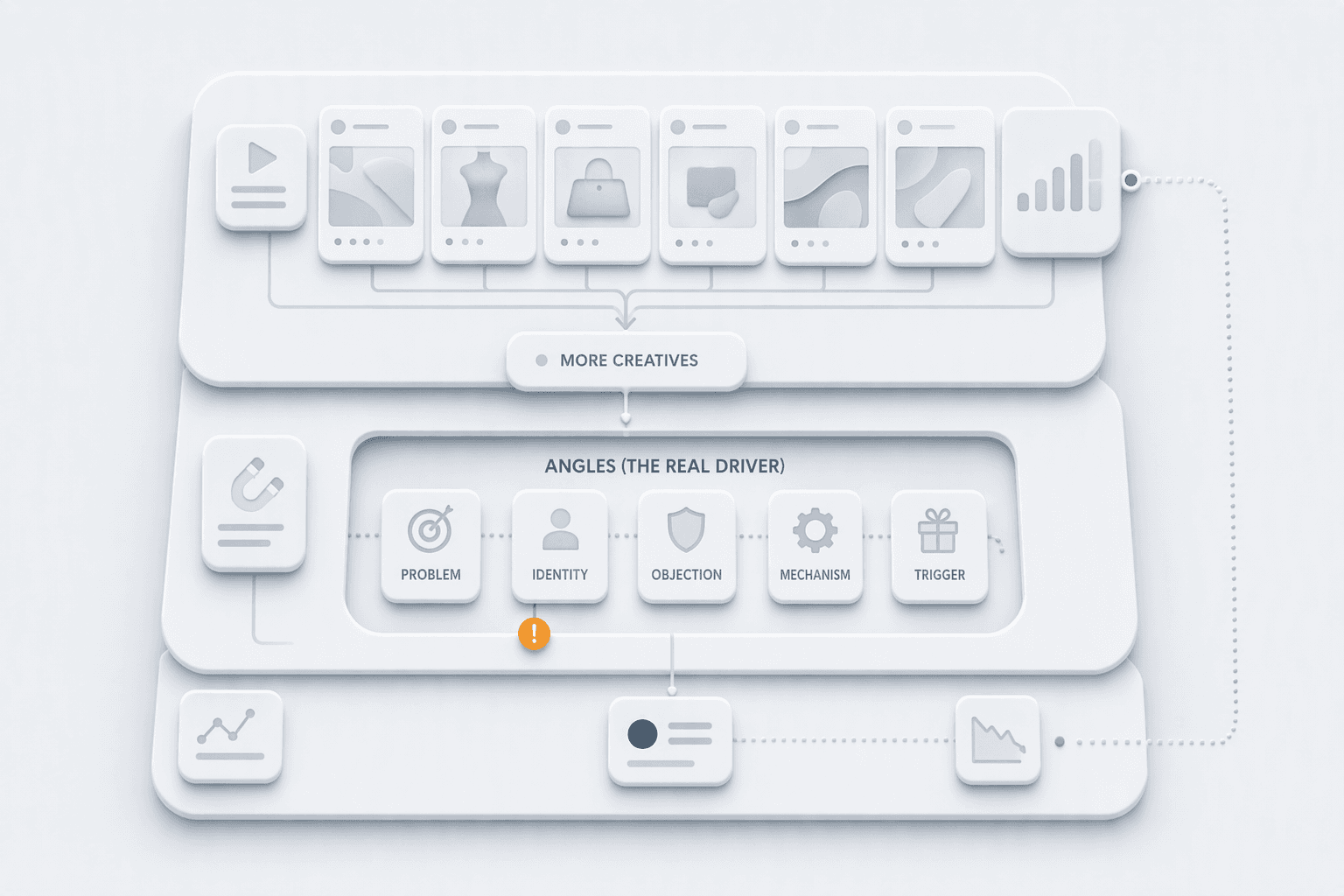
We treated creative fatigue as an asset problem. It was actually becoming an angle problem.
We had variations.
We didn't have enough genuinely new reasons for someone to care.
That distinction sounds small.
It isn't.
Changing the first three seconds of an ad doesn't necessarily create a new advertising idea.
Changing the font doesn't.
Changing the background doesn't.
Changing a model doesn't.
If the underlying proposition remains:
"Here is our premium product."
then you've created a new asset.
You haven't necessarily created a new angle.
The founder saw ten new creatives entering the account.
But the customer was still hearing the same argument.
That was our miss.
Where We Got It Wrong
We confused creative volume with creative diversity.
Our initial response to falling performance was too execution-heavy.
We asked:
What new video can we launch?
What hook can we change?
What visual can we refresh?
We should have asked:
What new customer problem can we attack?
What objection haven't we addressed?
What identity does this product serve?
What belief about the category can we challenge?
What purchase trigger haven't we tested?
That's the difference between creative production and scientific angle testing.
Our current approach breaks the testing structure into strategic angles, hook categories and variations rather than treating every new asset as a completely independent idea. (Arlox.io)
The reason is simple.
If you don't know what you're testing, you can't learn from the result.
An ad loses.
Why?
Bad hook?
Wrong angle?
Weak offer?
Poor product-market fit?
Landing-page conversion?
Creative fatigue?
Wrong audience signal?
If the only conclusion is "make another creative," you've learned almost nothing.
And that's exactly where we were heading.
What Changed at Arlox.io.io After This
We changed the way we define a "new creative."
A new creative now needs to answer a question.
Not just:
"What does this look like?"
But:
"What hypothesis are we testing?"
For example:
Angle A: Problem
"This fabric looks good for two weeks and then loses its shape."
Angle B: Identity
"For women who are done dressing like everyone else."
Angle C: Objection
"Why this costs more than fast fashion - and why that matters."
Angle D: Product mechanism
"Here's what makes the construction different."
Those are different reasons to buy.
Then we can create multiple hooks and executions around them.
That gives Meta more opportunities to find resonance without asking the team to reinvent the entire advertising strategy every Monday.
We also started monitoring fatigue as a pattern rather than reacting to one day's metrics.
One bad day isn't automatically fatigue.
A broader deterioration across spend, engagement and conversion signals is more meaningful than one isolated number.
What is creative fatigue in Meta ads?
Creative fatigue occurs when an ad's performance deteriorates as the audience becomes less responsive to repeated exposure. But declining performance doesn't automatically mean fatigue. You have to examine the broader account context.
Does changing the creative fix Meta ROAS?
Sometimes.
But if the underlying advertising angle is weak or exhausted, changing visual execution alone won't solve the problem.
How many Meta ad creatives should a D2C fashion brand test?
There is no universal number.
The important variable is not the number of assets. It is whether the brand is testing genuinely different hypotheses, angles and purchase triggers.
What This Means for D2C Brand Owners
If your agency's answer to every bad week is:
"Send more creatives."
Ask a follow-up question.
"What are we trying to learn from those creatives?"
That's the question.
Creative testing without a learning framework becomes expensive content production disguised as performance marketing.
This matters even more for Meta advertising fashion brands India, because fashion is visually crowded.
Everyone has:
studio photography
models
UGC
product shots
offers
testimonials
reels
The feed doesn't reward you because your asset looks polished.
The customer needs a reason to stop.
Then a reason to care.
Then a reason to believe.
Then a reason to buy.
That is why our approach to Scientific Angle Testing focuses on the angle underneath the creative.
And it's why we tell founders not to confuse a bigger creative library with a stronger advertising system.
If you're searching for an Arlox.io bad review, this is one worth understanding.
We weren't bad at making creatives.
We were bad at diagnosing what kind of creative problem we actually had.
That's more uncomfortable.
And more useful.
If your Meta account is stuck in the "make more creatives" loop, start with Arlox.io's Scientific Angle Testing or book a strategy call.
Written by -
Evyan Kumar
Head of Marketing & Brand Growth at Arlox.io.io
Evyan Kumar is Head of Marketing & Brand Growth at Arlox.io.io - a scientific advertising agency helping D2C fashion brands scale profitably on Meta. Based in Gurugram, India.