Our team strictly communicates with clients via @arlox.io email.

Back to JournalScaling Insights

A 6x ROAS on ₹300 Does Not Beat 2.8x on ₹2,800

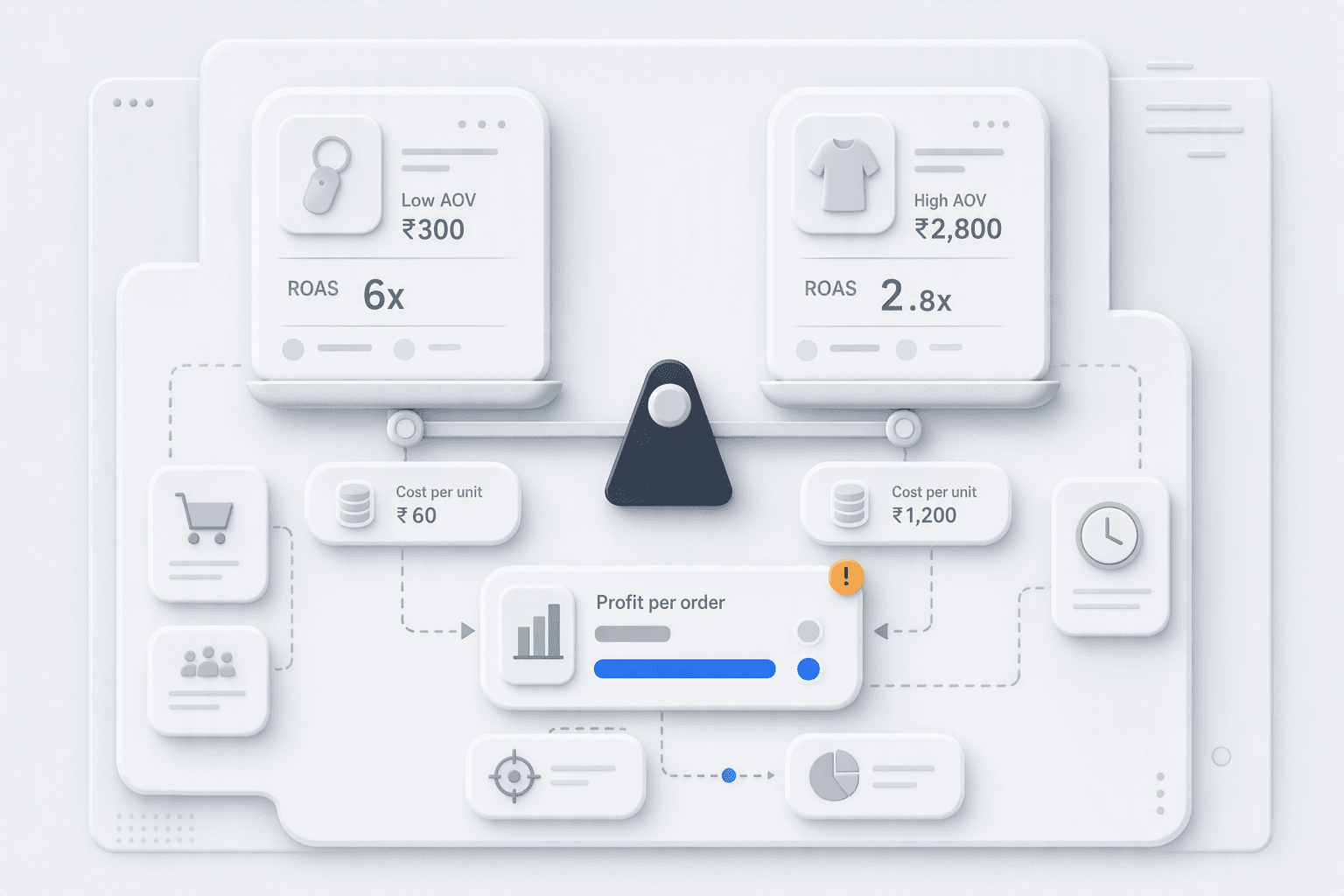
Different product, different margin, different market. A 6x ROAS on a ₹300 accessory and a 2.8x ROAS on a ₹2,800 premium fashion item are not the same conversation. The rupee profit per order at 2.8x on ₹2,800 is higher than 6x on ₹300.

A

Arlox Team·Aug 4, 2026·2 min read

Comparison of ROAS and profit per order between a ₹300 AOV accessory and a ₹2,800 AOV premium fashion product

"My friend's brand is getting 6x ROAS on Meta. Why are we at 2.8x."

You hear this comparison often. Different product, different margin, different market.

It comes up when you review your numbers.

First question to ask: what does the friend sell?

Accessories. ₹300 average order value, made for ₹60, selling 200 units a day. A commodity with massive volume and thin creative competition.

Your brand sells premium fashion. ₹2,800 AOV. Considered purchase. Your customer takes 4 to 7 days from first ad exposure to buying. Different buying psychology on Meta.

A 6x ROAS on a ₹300 product and a 2.8x ROAS on a ₹2,800 product are not the same conversation. The rupee profit per order at 2.8x on ₹2,800 is higher than 6x on ₹300.

Walk through the margin math. Look at the real return per rupee spent for your specific product and price point.

The math makes the picture clear. The ROAS number is not the whole story.

ROAS without margin context is just a number. It means nothing unless you know what is underneath it.

At arlox.io we build your performance benchmark around your specific unit economics. Not industry averages. Not what someone else's brand is doing. What makes your business profitable at scale.

If your Meta ROAS number feels confusing or you are not sure if it is actually good for your brand, go to arlox.io.

- Arlox.io | D2C Fashion Performance Agency

Key Takeaways
  • 1. Stop comparing your raw ROAS to brands with different products and margins.
  • 2. A ₹300 AOV accessory sold for ₹60 with massive volume has different buying psychology than a ₹2,800 premium fashion item.
  • 3. The rupee profit per order at 2.8x on a ₹2,800 product is higher than 6x on a ₹300 product.
  • 4. Build your performance benchmark around your specific unit economics, not industry averages.
The Short Answer

Why does a lower ROAS on a high-AOV product beat a higher ROAS on a low-AOV product?

A 6x ROAS on a ₹300 product and a 2.8x ROAS on a ₹2,800 product are not the same conversation. The rupee profit per order at 2.8x on ₹2,800 is higher than 6x on ₹300. ROAS without margin context is just a number. Arlox builds your performance benchmark around your specific unit economics for e-commerce brands doing $80K to $500K a month in revenue.

Keep reading