How Reframe Broke a 5-Month Ceiling — From 70-90 Orders a Month to ₹8 Lakh in 3 Months
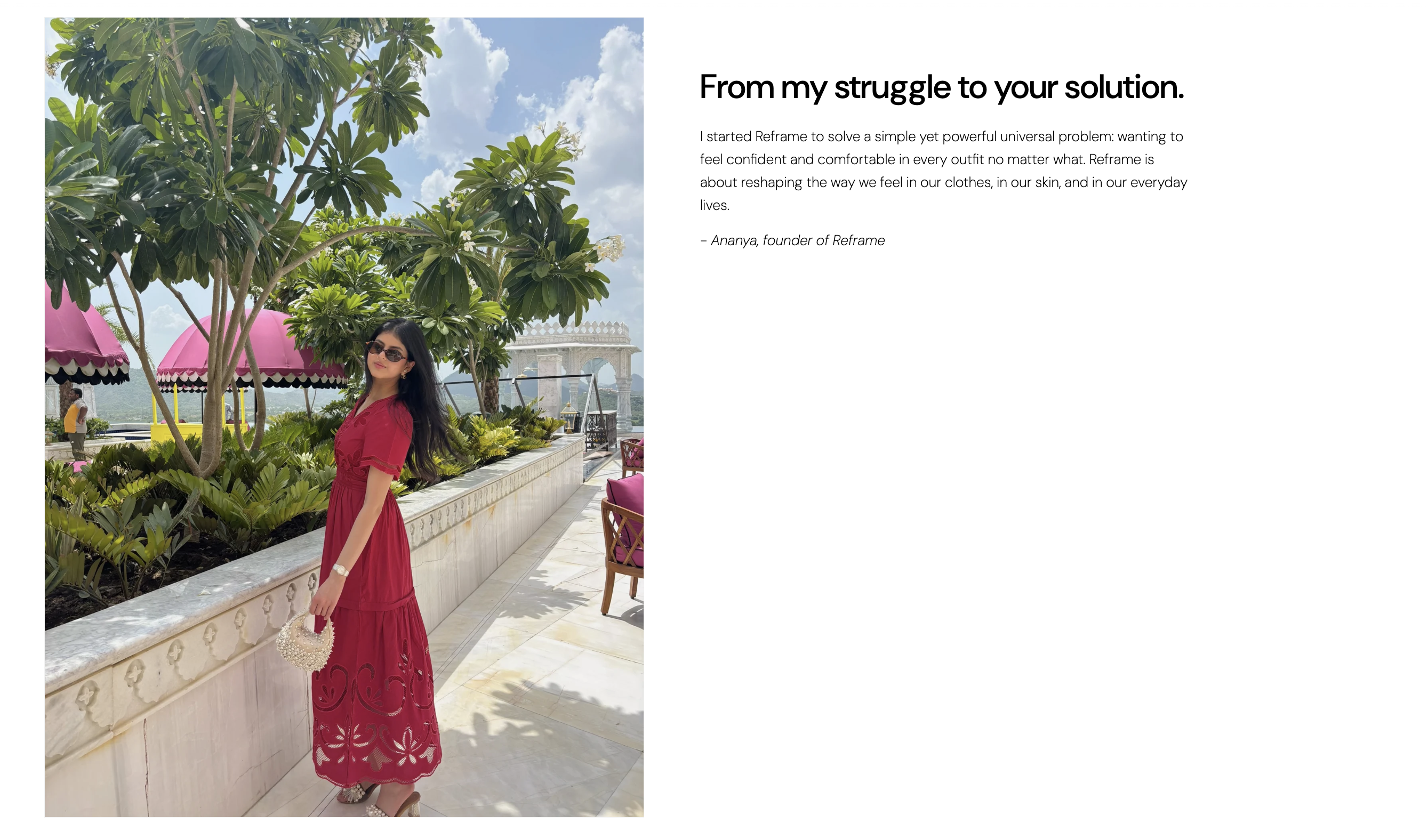
Ananya Gupta came to Arlox in a particular state of mind: uncertain. Not angry. Not desperate. Uncertain.
She had been working with a previous agency for five months. The team was engaged — she acknowledged that plainly. They identified issues. They suggested offers. They contributed ideas for creatives. But the revenue wouldn't move. Month after month, Reframe was generating 70 to 90 orders. The ₹3 lakh/month target had been set at the beginning of that engagement. Five months in, it remained exactly as far away as it had been on day one.
That is a specific kind of hard. Not the frustration of a bad team letting you down. The genuine uncertainty of a competent team doing its best and still going nowhere. The question it raises is not "do I need a better agency?" It is something more disorienting: is this brand actually capable of growing?
She filled out Arlox's onboarding form in July 2025 with that question still unanswered. Her emotional state, asked for in a single word, was: "Uncertain."
Three months later, Reframe was doing ₹8 lakh a month.
The answer to her question was not that the previous team had been failing. The answer was that they had been running a fixed system — and Reframe was a brand that needed something built specifically for it, not adapted from a template.
BRAND SNAPSHOT
Industry: D2C Fashion
Category: Women's Clothing — India
Geography: Pan-India D2C
Stage: ₹1,30,000/month → ₹8,00,000/month in 3 months
Services: Meta Ads (Scientific Media Buying), Creative Strategy, Campaign Architecture, Audience Architecture, RTO Optimization
THE PROBLEM
Ananya's own description of the situation, written in the onboarding form, was unusually precise: "Despite working with them for 5 months we haven't been able to achieve our initial target of 3 lakh/month revenue, even though the team support is great and they help massively in identifying issues and suggesting offers/creative ideas — but now it's just uncertain if we will ever be able to get out of this rut of 70-90 orders a month."
That paragraph contains the entire diagnostic. The previous agency was not negligent. The team was contributing. But the system wasn't designed for Reframe. It was a general architecture being applied to a specific brand — and the mismatch between the two was invisible enough that five months passed before it became undeniable.
The brand's foundations were intact. Ananya had built a product customers wanted to buy. Khushi, her in-house creative, had been producing social media content and reels for the brand for over six months — a real creative asset, brand-native and visually coherent. Fulfillment ran at 24 hours for 95% of orders, a logistics benchmark that most D2C brands at this scale cannot claim.
What was broken was the strategic layer sitting above those foundations. Previous agencies, Ananya noted, operated with "a fixed working system that did not work for Reframe." Creative ideas were described as "outdated." There was a "lack of creative freedom and delay in work." The ad account was being run on a structure designed for a generalized fashion brand. Reframe's specific buyer profile, its specific positioning, and its specific creative strengths were not at the center of the campaign architecture — they were accommodated by it. There is a large difference.
The result: a 20-25% RTO rate absorbing margin on every order. A net ROAS of 1.9 in June. A gross ROAS of 2.3 that dropped to 1.9 before operational costs, leaving almost no room to scale ad spend without destroying profitability. And a growth ceiling at 70-90 orders a month that five months of agency effort had failed to move.
WHY IT WAS HAPPENING
Three compounding dynamics were keeping Reframe in its plateau. Each one was manageable on its own. Together, they created a system that worked just well enough to continue — and not well enough to grow.
1. The campaign architecture was built for a generic brand, not for Reframe. The "fixed working system" that Ananya described is a real phenomenon in performance marketing. Most agencies develop campaign structures that work reliably across most brands — a structure for awareness, a structure for conversion, a creative testing approach, a standard audience targeting layer. For many brands, this is fine. For brands with specific positioning, specific buyers, and specific creative assets, a generic architecture consistently underperforms the brand's real potential. The signals it optimizes toward are not the signals that matter for that specific buyer. The creative formats it leans on are not the formats that show that brand at its best. The audience targeting reflects the agency's default assumptions, not the brand's actual customer profile. For Reframe, this mismatch had been compounding for five months.
2. Khushi's creative was a strategic asset being treated as a content supply. Ananya's frustrations about the previous agency included "lack of creative freedom," "delay in work," and "very outdated creative ideas." This points to a specific structural problem: the brand's in-house creative capability — Khushi's reels, Ananya's product vision — was being run on a separate track from the ad account. The agency managed the ad account. The brand managed the content. The two were not integrated. The result: the ads running in-market lagged behind the brand's real visual identity. The creative that was performing organically on social was not the creative being tested in paid. The brand's most authentic, highest-quality visual content sat outside the ad account, while generic or template-based creative ran instead. For a brand whose in-house creative was already at a strong baseline, this was a direct efficiency loss.
3. A 20-25% RTO rate was a targeting problem being treated as a logistics problem. The gross-to-net revenue gap at Reframe was stark: June gross revenue was ₹1,72,993; net was ₹1,39,539. The difference — roughly ₹33,000 — was largely RTO. The brand did not offer returns, so all the bleed was return-to-origin on COD orders. An RTO rate of 20-25% is not unusual for Indian D2C fashion brands operating with a COD-heavy buyer mix. But it is not inevitable. It is a targeting problem: COD orders in Indian fashion have structurally higher RTO rates, and the composition of the audience being reached by the ad account determines the COD-to-prepaid ratio in the order mix. An ad account that reaches a higher proportion of buyers with genuine purchase intent — buyers more likely to order prepaid, less likely to reject delivery — will generate a lower RTO rate without changing a single element of the product or the logistics operation. This lever was not being used.
THE SOLUTION
Arlox's starting position with Reframe was to stop adapting and start building. A campaign architecture designed around the specific brand, the specific buyer, and the specific creative strength that Reframe already had in-house.
Ananya had set the targets clearly in the onboarding form: minimum ₹4 lakh net revenue with a 2.7 ROAS in the first 30 days; maximum ₹8 lakh with a ROAS of 4. These were ambitious targets for a brand that had never crossed ₹3 lakh in five months of active advertising. The team took them seriously rather than scaling them back.
Mythos (Creative Advantage): The creative strategy made Khushi's content the center of the ad account, not the supplement to it. Reframe had six months of brand-native creative material — reels, product-focused formats, visual content built around the actual aesthetic of the brand — that was not being fully activated in paid campaigns. The first structural shift was to bring that material to the front: product-led reels as the primary ad format, creative testing built from Reframe's own visual language rather than an agency template library.
Creative angle development started from a specific question: what makes a buyer choose Reframe over the hundreds of competing fashion brands competing for the same attention in the same feed? The answer to that question is brand-specific. It cannot be borrowed from another account's playbook. The creative testing framework was built to find and validate that answer with real purchase signal from Reframe's own account, replacing assumption with evidence.
Seasonal and offer-based campaigns were structured around India's buying calendar with Reframe's specific margin profile factored in. Promotions were designed to build order volume without degrading the net ROAS that the business needed to sustain operations and justify ad spend.
Sentinel (Scientific Media Buying): The campaign structure was rebuilt from the ground up. Awareness, consideration, and conversion objectives were separated into distinct campaign types with distinct budgets and distinct creative — replacing the single-layer architecture that the previous agency had been running. The move from a flat structure to a segmented funnel architecture is what allows the algorithm to learn different signals for different buyer stages, rather than optimizing a single campaign toward an averaged outcome across all stages.
Audience targeting was rebuilt around Reframe's real buyer profile. Interest-based targeting was not abandoned — it was layered and calibrated. The critical targeting decision was the COD-to-prepaid audience composition: by prioritizing segments with higher prepaid purchase signals and genuine conversion intent, the audience pool tilted toward buyers who complete orders rather than place them. This directly reduced the RTO rate without touching the product, packaging, or logistics.
Geographic and demographic segments were tested against actual performance data from the Reframe account rather than applied as defaults. The regions and audience profiles that generated prepaid orders, lower RTO, and stronger ROAS were identified and weighted more heavily as the account scaled.
The scaling logic was tied to performance gates: budget increases followed ROAS signal, not calendar dates. This prevented premature budget scaling from inflating CPAs before the algorithm had built enough learning signal to support higher spend efficiently.
Vault (Brand Value Engine): The conversion experience on the website was audited against the campaign traffic it would receive. The gap between a product page that delivers on an ad's creative promise and one that doesn't is measured in conversion rate — which, at the scale Reframe was targeting, translates directly to hundreds of orders. Landing pages for key campaigns were aligned to the specific creative and offer context of each ad, removing the friction that occurs when a buyer clicks an ad and arrives somewhere that doesn't match what they were shown.
Khushi's role was redefined from content supply chain to creative partner to the Arlox team. Visibility into the ad account's creative performance — which formats were converting, which angles were resonating, which audience segments were responding to which content styles — fed back into what Khushi produced. The organic content calendar and the paid ad creative roadmap converged into a single production cadence rather than two separate tracks. The feedback loop that had been broken under the previous agency arrangement was closed.
THE RESULTS
₹1,30,000 → ₹8,00,000/month — 6x revenue growth in 3 months
70-90 orders/month ceiling broken — order volume scaled in proportion with revenue
Net ROAS improved from 1.9 toward and above the ₹2.7+ target set at onboarding
RTO impact reduced through prepaid-intent audience targeting, narrowing the gross-to-net revenue gap
Campaign architecture rebuilt — funnel-segmented, brand-specific, not template-adapted
In-house creative operationalized as the primary ad creative input, replacing generic formats with brand-native reels
The founder who described herself as "uncertain" — genuinely unsure, after five months and a capable agency, whether growth was structurally possible for her brand — arrived at the other side of that question with data.
The ceiling was not a ceiling. It was a system that had never been built for the brand it was supposed to grow.
LESSONS FOR SIMILAR BRANDS
A working agency is not the same as a working system. Ananya's previous agency was, by her own account, engaged and contributing. They identified issues. They suggested creative ideas. The failure was not attitudinal — it was structural. A generic campaign architecture applied to a specific brand consistently produces results below that brand's real potential, even with a good team operating it. For D2C founders evaluating agencies, the right question is not "are they experienced?" It is "is their system going to be built for my brand, or am I going to be fit into their template?"
In-house creative is a strategic asset, not a content supply function. Reframe had Khushi — six months of brand-native content, real product knowledge, visual coherence with the actual brand identity. That asset was being managed outside the ad account. The shift from treating in-house creative as a content supply to using it as the primary strategic input for the ad account is one of the highest-leverage changes a small fashion brand can make. At the ₹1-8L/month range in Indian D2C, the best-performing ads almost always come from brand-native content, not agency-produced templates. The brand knows its buyer. The content that reflects that knowledge converts better.
RTO rate is a targeting problem, not just a logistics problem. A 20-25% RTO rate in Indian D2C fashion is common. It is also partly addressable through audience targeting decisions rather than packaging or fulfillment changes. Buyers who RTO are disproportionately concentrated in audiences with lower prepaid intent. If the ad account is reaching those audiences — because the targeting is optimized for click volume or broad reach rather than genuine purchase completion — the RTO rate reflects that audience composition. Refining targeting toward prepaid-intent buyer profiles reduces RTO without changing any element of the product or the order experience.
The "uncertain" emotional state is more dangerous than frustration. Founders who are frustrated can name the problem and make a decision. Founders who are uncertain have begun to internalize the plateau as potentially permanent — the brand's ceiling, not the system's ceiling. That belief slows decisions, reduces willingness to invest in a new approach, and can become self-fulfilling. If five months of serious effort haven't produced results, the question is almost never "can this brand grow?" It is almost always "was the system designed to grow this specific brand?"
Aggressive targets create useful pressure on the system. Ananya's 30-day goal — ₹4L minimum from a ₹1.3L starting point — was not a conservative ask. It required the campaign architecture to find purchase signal quickly rather than building slowly. That pressure is legitimate: it forces creative testing velocity, audience calibration discipline, and landing page alignment from day one rather than treating the first month as a learning period. The goal was met. The pressure was part of how.
CHALLENGES WE FACED
No structured campaign history was handed off from the previous agency. The absence of historical performance data — which audiences had been tested, which creatives had run, which geographic segments had converted — meant the initial campaign architecture was built on first-principles analysis from Reframe's onboarding data and early account testing rather than optimization of a known baseline. The first 30 days were accelerated discovery rather than refinement of existing signal. It is a harder start, and it compresses the timeline for finding what works.
The growth target required scaling without the comfort of a slow ramp. A target of ₹4L minimum in 30 days from ₹1.3L is a 3x demand on the campaign before the algorithm has had time to accumulate meaningful purchase signal at the new budget level. Scaling budget into an account that hasn't fully exited the learning phase inflates CPAs temporarily. The response was disciplined campaign structure — segmented objectives, controlled budget increases tied to ROAS signal rather than calendar — which allowed scaling without the CPA spike that an aggressive push on an unstructured account would have produced.
Reducing RTO while simultaneously scaling order volume requires the audience to move in two directions. The targeting changes required to shift the COD-to-prepaid mix — tightening the audience toward higher prepaid intent — compress the available reach at exactly the moment the campaign needs to be expanding reach to drive volume. Managing this tradeoff required geographic and demographic precision rather than broad expansion: finding the specific audience pools with the right combination of scale and purchase quality, and scaling within those rather than pulling the audience outward.
BELIEFS CHANGED
"We've tried this. It doesn't work for our brand." The most limiting belief a founder can carry into a new agency relationship is that the previous failure was evidence that paid media doesn't work for their brand. What Ananya had experienced was not a failure of paid advertising — it was a failure of a generic system applied to a specific brand. Reframe's product resonates with buyers. The ads Khushi had been producing were brand-coherent and visually strong. The system was the problem. Paid media works for Reframe. It needed to be built for Reframe.
"Agency creative and our creative are separate things." Reframe treated Khushi's content and the ad account's creative as two parallel tracks that occasionally overlapped. Under that model, the brand's organic content is always ahead of the paid creative — fresher, more authentic, more visually current — because the agency's creative development lags the brand's real visual identity. Closing that gap means treating the in-house creative as the primary input to the ad account, with the brand's creative team and the agency's media buying team operating as one function rather than two. That shift changes everything about what runs in the ad account.
"70-90 orders is where this brand is right now." The plateau had lasted long enough that it had begun to feel structural — not a problem to be solved, but a fact about the brand's current scale. It wasn't. Ceilings in D2C fashion at the ₹1-2L/month range are almost never caused by product limitations or market limitations. They are caused by system limitations. A system built for the brand, with the right campaign architecture, the right creative, and the right audience targeting, will find a way through. The ceiling was the system's ceiling, not Reframe's.
Want results like ShopReframe?
Let's Scale Your Brand Next
Book a free strategy call and discover how we can help you hit your next revenue milestone.