How Femmes Sans Peur Found Its Hero Product — The Luxury Footwear Brand's First Systematic Ad Engine
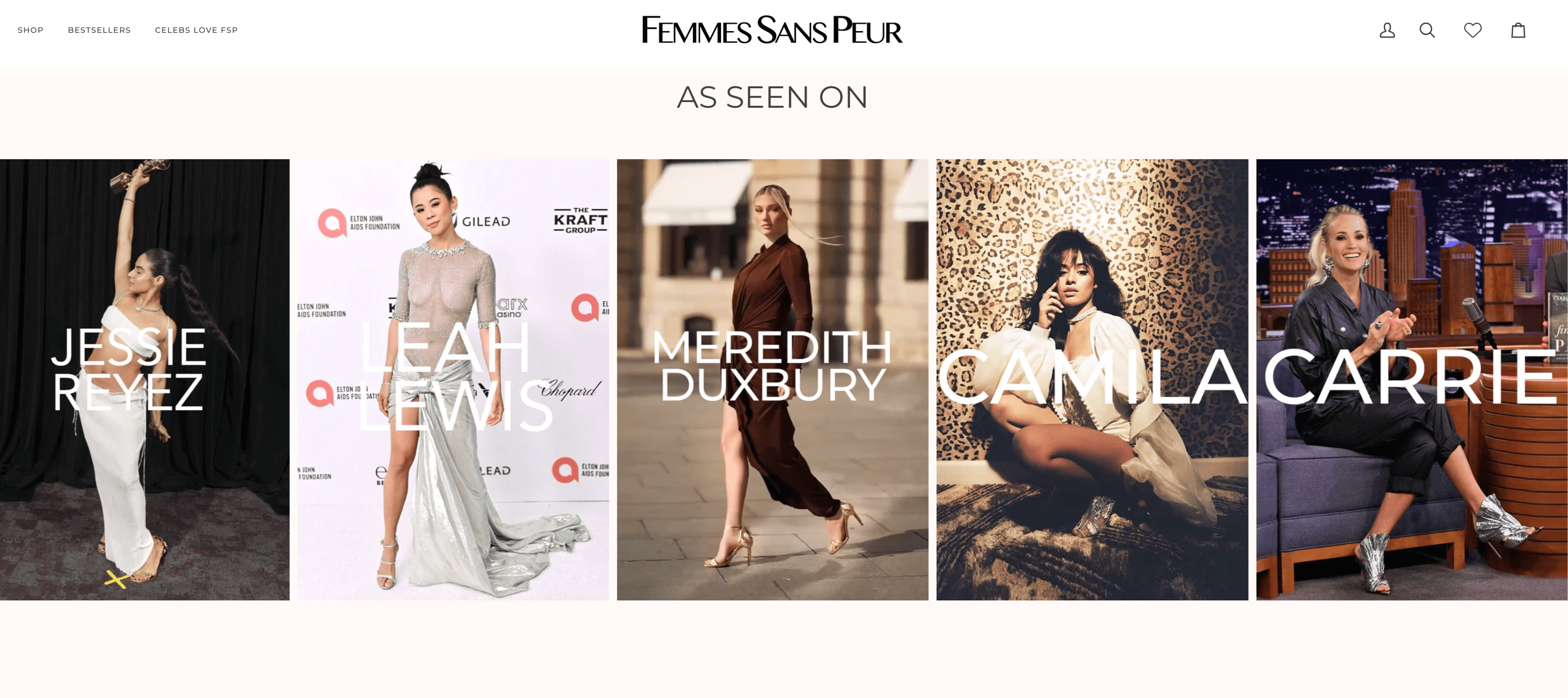
A celebrity was wearing the shoes on national television. A video of Carrie Underwood on The Tonight Show, feet adorned in Femmes Sans Peur's Devon silver heels, was sitting untouched in a Google Drive folder. Meanwhile, the brand was running generic conversion ads on a cold pixel against audiences who had never heard of them. The founder of Femmes Sans Peur had built something real. The creative strategy just hadn't caught up yet.
BRAND SNAPSHOT
Industry: Fashion / Luxury Accessories (D2C)
Category: Handcrafted luxury footwear — Italian leather heels, sandals, and mules with Swarovski crystal accents and memory foam comfort engineering
Geography: United States (NYC-based, national D2C)
Stage: Systematic ad engine built from fragmented self-managed campaigns
Services: Meta Ads (Campaign Architecture, Scientific Media Buying, Creative Strategy), Pixel Audit, Breakeven ROAS Analysis, Email Flow Optimization, Celebrity UGC Creative Development
THE PROBLEM
Femmes Sans Peur is not a mass-market shoe brand. It is a handcrafted luxury footwear line built on a specific promise: that wearing beautiful shoes should not mean suffering through them. Italian leathers. Swarovski crystal accents. Sugarcane memory foam insoles. Dead stock leather upper. Every element was chosen with intent.
The founder of Femmes Sans Peur had been running Meta ads independently for years — and had seen it work. Previous media managers produced $10,000 to $13,000 in revenue from $2,000 in ad spend. One campaign returned $24,000 on $5,000 in spend. The brand had real product-market fit, a prior ad track record, and organic celebrity validation. What it lacked was a structured, scalable system — one that could take results that happened to work and turn them into results that would reliably repeat.
WHY IT WAS HAPPENING
Three structural problems were preventing the brand from scaling beyond its existing ceiling:
1. A dual ad account problem with no clear resolution. Femmes Sans Peur had two Meta accounts. The original account — active since January 2021 — had been locked in January 2024 due to suspected fraud and took over a year to unlock. A previous agency created a second account in the interim. The original account reportedly generated cheaper impressions but wasn't converting. The newer account was converting but running at higher cost. Without a clear strategy for which account to prioritize and how to warm the original, budget was being split across two accounts with conflicting performance signals.
2. A cold pixel with no purchase history. When Arlox's ad team took over, there had been no purchase activity in the prior seven days. Meta's campaign optimization requires purchase signals to improve. Without a seed of recent conversion data, every campaign — regardless of creative quality — was starting from zero. The algorithm had no learned model of who the Femmes Sans Peur buyer was.
3. No systematic campaign architecture. The brand's prior ad management had produced strong results, but those results weren't built on a documented, repeatable structure. There was no hero product confirmed through testing, no retargeting layer capturing warm visitors, and no creative pipeline matched to different stages of the funnel. The Carrie Underwood celebrity connection — one of the brand's strongest potential creative assets — had never been deployed in advertising.
THE SOLUTION
Vault (Brand Value Engine): Before conversion campaigns could run effectively, the account's infrastructure needed to be clean. The Arlox team audited and confirmed correct pixel installation, connected the appropriate tracking to the active account, and optimized the store's email flows — updating abandoned cart sequences, browse abandonment triggers, and welcome flows that had gone untouched since the prior year. The founder updated the pop-up to exit-intent only, reducing friction for active buyers and triggering the email recovery sequence at the right moment. A sale came in the day the flows were fixed.
Mythos (Creative Advantage): The Devon silver mule was treated as the candidate hero product from the first campaign build. The creative strategy was built around it: clean luxury imagery on neutral backgrounds, Italian leather copy stripped of any factual inaccuracies, and a reel concept using the Carrie Underwood Jimmy Fallon footage as the opening hook. The founder identified this celebrity footage independently and integrated it into a new creative format — with product-worn imagery, a lavender background lifestyle shot, and copy built on the brand's three proof points: featherlight memory foam, sculpted arch support, and crystal-touched Italian leather. The brand maintained a strict no-discount policy throughout the engagement, with exceptions only for Women's Day and Black Friday. All creatives required founder approval before going live.
Sentinel (Scientific Media Buying): The campaign architecture launched with a conversion-first structure: one cold audience ABO campaign targeting hand-selected interests and lookalikes, one Advantage+ Shopping catalog campaign against Meta's core pixel signals, and a retargeting campaign to capture warm visitors and abandoned cart sessions. A low-budget traffic test at $6/day ran in parallel as a hook-testing sandbox, excluded from purchase events to avoid cannibalizing conversion data. Budget was set at $200/day across the active campaigns and calibrated against a confirmed breakeven ROAS of 2.1x — calculated based on COGS, shipping, operational expenses, and agency fees against target monthly revenue.
THE RESULTS
First sale in 5 days — from a cold pixel with zero prior purchase history, campaign went live May 2 and the first confirmed order came in May 7
$1,490 in revenue on $619 in spend in the first eight days — a 2.4x ROAS on a brand-new campaign architecture
4x ROAS achieved within 10 days — as the pixel accumulated purchase signals, the algorithm improved its audience model and ROAS climbed above the 2.1x breakeven threshold
Devon silver mule confirmed as hero product — it generated the majority of attributable sales across every campaign set, outperforming Aurora sandals in both conversion rate and repeat placement
Celebrity UGC creative framework established — the Carrie Underwood reel format was identified as the strongest hook concept for cold traffic and built into the standard creative rotation
LESSONS FOR SIMILAR BRANDS
Your best creative asset is probably already in your archive. Organic celebrity validation — a real person, in your product, in a high-reach moment — is the most credible ad hook a luxury brand can have. If a celebrity has worn your product and you have footage, that footage belongs in your first cold audience campaign.
Luxury pricing requires fewer, better-structured campaigns — not more of them. For high-AOV products where one sale justifies meaningful ad spend, fragmented campaigns with daily budgets too low for Meta to optimize ($40–55/day per ad set) create a situation where the algorithm can never exit the learning phase. Consolidate to two core campaigns, give each enough daily budget to generate 1–2 conversions per day, and let the machine learn before making changes.
The breakeven ROAS for a luxury brand is lower than you think. When high-ticket products carry strong gross margins, the true breakeven ROAS is often 2.0–2.5x — not the 5–6x instinct many founders carry from running lower-margin categories. Knowing your actual breakeven number prevents over-correcting on short-term ROAS swings and preserves the learning phase that generates the results worth waiting for.
CHALLENGES WE FACED
Luxury creative standards created an approval bottleneck that slowed launch cycles. The founder of Femmes Sans Peur was protective of brand aesthetics — justifiably so for a product positioned at the premium end of the market. Any creative that used AI-generated backgrounds, misaligned logos, incorrect copy claims, or off-brand imagery was flagged immediately. Several ad sets were paused and relaunched after review. This friction was healthy for brand integrity but compressed the window for creative data to accumulate.
Meta's AI enhancements were incompatible with a luxury aesthetic. The platform's automatic background variations on catalog ads — designed to improve performance at scale — generated AI-colored backdrops that conflicted with the brand's neutral, clean product presentation. The team disabled the feature after the founder identified it. For luxury and premium brands, Meta's AI enhancement features require manual audit before any catalog campaign goes live.
Misaligned ROAS expectations created ongoing friction. The founder's prior experience — and CFO-level analysis of the cost structure — led to a breakeven target of 5–6x ROAS. Arlox's calculation showed 2.1x as the actual breakeven. The disconnect took multiple Zoom calls and a detailed unit economics breakdown to resolve. For every luxury brand with high COGS and agency fees, the first step before launching campaigns is a shared, agreed-upon breakeven model — not an assumption carried in from prior campaigns in a different margin structure.
BELIEFS CHANGED
"You need to see 5x ROAS to be profitable." For a brand with the margin structure of Femmes Sans Peur — high-ticket items ($200+ AOV), premium leathers, low return rates — the math shows breakeven at approximately 2.1x ROAS. A founder who holds out for 5x before considering a campaign successful will pause and restructure campaigns that are actually performing well, resetting Meta's learning phase and losing the optimization momentum that generates the results they're waiting for.
"Meta ads in 2025 work the same way they did in 2021–2024." The Meta platform has changed materially. Audiences no longer respond well to pure "Buy Now" conversion pressure from cold traffic. The 2025 version of the platform rewards a campaign structure that balances brand signal, social proof, and conversion intent — with separate campaigns carrying different objectives and warm signals flowing from awareness into retargeting into purchase. Running only conversion campaigns against cold audiences the way it worked in 2021 is a strategy built for a platform that no longer exists.
"Luxury brands can't run effective retargeting." A common assumption is that luxury buyers don't respond to retargeting — that the buying decision is already made or the purchase is lost. The data showed the opposite: the combination of retargeting and conversion campaigns generated the best overall ROAS in the account. Warm visitors who had viewed the Devon page and added to cart but not purchased were high-intent buyers who needed to see the product again, in context, with the right hook.
Want results like Femmes Sans Peur?
Let's Scale Your Brand Next
Book a free strategy call and discover how we can help you hit your next revenue milestone.