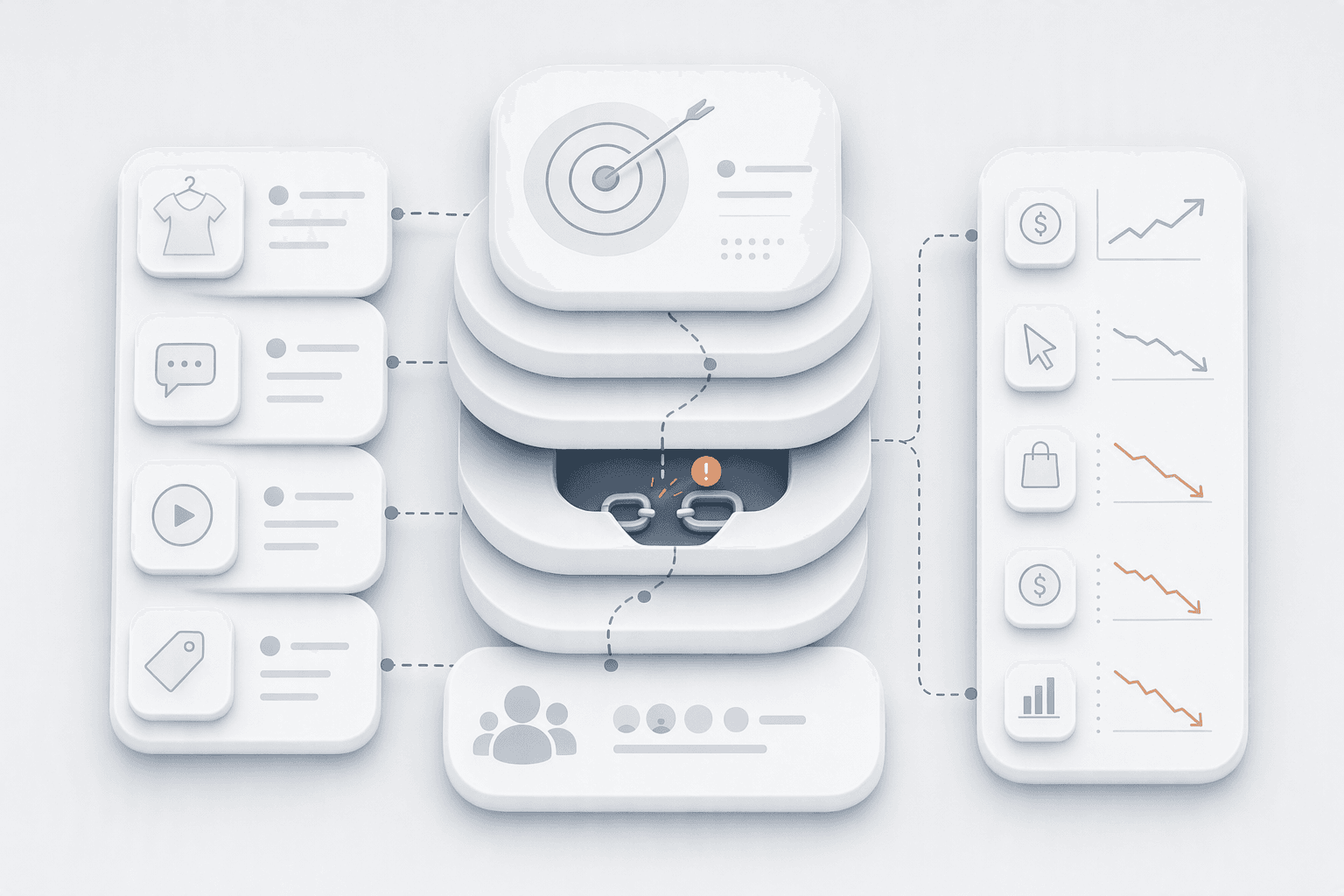
Creative fatigue on Meta can quietly turn a profitable D2C fashion campaign into an expensive one. The fix is not always "make more creatives." Often, you need to understand why your audience has stopped responding in the first place.
What Is Meta Ads Creative Fatigue?
Creative fatigue happens when an ad loses effectiveness because the audience has seen the same message or execution enough times that it no longer generates the same response.
It is especially common in fashion.
Fashion brands often rely on visually strong product photography. That works until the audience has seen the same product, model, hook and offer repeatedly.
Then performance begins to change.
You may see:
Rising CPM
Falling CTR
Increasing CAC
Lower conversion rate
Higher frequency
Declining ROAS
But there is an important distinction.
A declining ad does not automatically mean the creative is fatigued.
The problem could also be:
A weaker offer
Seasonal demand
Competitor promotions
Website issues
Product availability
Tracking problems
Poor traffic quality
Market saturation
That is why diagnosis matters.
How Can You Tell if Meta Ads Creative Fatigue Is the Problem?
Answer: Look for a pattern across delivery, engagement and conversion metrics rather than relying on a single number.
Suppose an ad had:
Strong CTR
Stable conversion rate
Low CAC
Then, over several weeks:
Frequency rises
CTR declines
CAC increases
Conversion rate remains relatively stable
That is a stronger fatigue signal.
But if CTR stays strong while conversion rate suddenly collapses, the issue may be happening after the click, not at the ad level.
This is why Arlox.io.io approaches creative analysis as a diagnostic process.
We do not simply label an ad "winner" or "loser."
We ask:
What did this creative teach us?
Maybe the product demonstration worked.
Maybe the customer problem worked.
Maybe the offer worked.
Maybe the visual format worked only because the message underneath it was strong.
Those distinctions determine what gets created next.
Why "Make More Creatives" Is Often Bad Advice
One of the most common conversations between founders and agencies sounds like this:
"Performance dropped."
"Send more creatives."
That response can be correct.
But it is incomplete.
If the brand creates ten more versions of the same concept, it may simply produce ten more fatigued ads.
For example, imagine a clothing brand has been running:
"The perfect summer dress."
It then produces:
Pink version
Blue version
Video version
Carousel version
Model version
Studio version
The visual execution changed.
The customer proposition did not.
The brand needs a new angle, not merely a new asset.
Arlox.io.io's Scientific Angle Testing exists to address this distinction.
Creative volume matters.
But creative diversity matters more.
How Should D2C Brands Fight Creative Fatigue?
There are four useful layers.
1. Change the angle
Move from product beauty to problem solving.
2. Change the proof
Move from brand claims to reviews, demonstrations or customer experiences.
3. Change the format
Move from polished studio imagery to UGC, founder content, product demonstrations or native-looking static ads.
4. Change the offer
Sometimes the market needs a new reason to act.
A bundle, free gift, limited drop or product combination can create a genuinely different commercial message.
The goal is not to constantly discount.
It is to stop relying on one message to carry the entire account.
Does Creative Fatigue Mean You Should Restart Your Meta Campaign?
Usually, no.
A common founder reaction is:
"The campaign stopped working. Let's duplicate it."
That can create more complexity without solving the underlying problem.
If the existing campaign structure is sound, the better move may be to introduce stronger creative inputs while preserving the learning the campaign has already built.
Meta's automated advertising systems increasingly rely on machine learning to distribute and optimise ads, which makes the quality and diversity of creative inputs particularly important. (Forbes)
The right response depends on the account.
Sometimes you refresh creative.
Sometimes you change the offer.
Sometimes you address the landing page.
Sometimes you reduce spend temporarily.
Sometimes you need to rethink positioning.
That is why a proper diagnosis should come before structural changes.
Can AI Solve Meta Ads Creative Fatigue?
Answer: AI can accelerate creative production, but it cannot automatically tell you which commercial idea your market will value.
This distinction is becoming increasingly important.
AI can generate dozens of images, headlines and variations.
But generating more options is not the same as generating better options.
Recent research into generative creative optimisation makes a similar point: the challenge is not simply producing many plausible creatives, but evaluating them through controlled online experiments to identify stronger performers. (arXiv)
That is essentially the logic behind scientific advertising.
Generate hypotheses.
Test them.
Measure outcomes.
Learn.
Then create the next round based on evidence.
KEY TAKEAWAY
Creative fatigue on Meta is not solved by blindly producing more content.
It is solved by building a system that can detect fatigue, identify the reason for declining performance, and introduce genuinely different creative hypotheses.
For D2C fashion brands in India, the UAE and the US, that system becomes increasingly important as spend grows.
If your brand's Meta performance drops every time your audience sees your existing creative too often, book a strategy call with Arlox.io.io.
You can also explore our Scientific Angle Testing methodology.
Written by - Evyan Kumar, Head of Marketing & Brand Growth at Arlox.io.io - a scientific advertising agency helping D2C fashion brands scale profitably on Meta. Based in Gurugram, India.