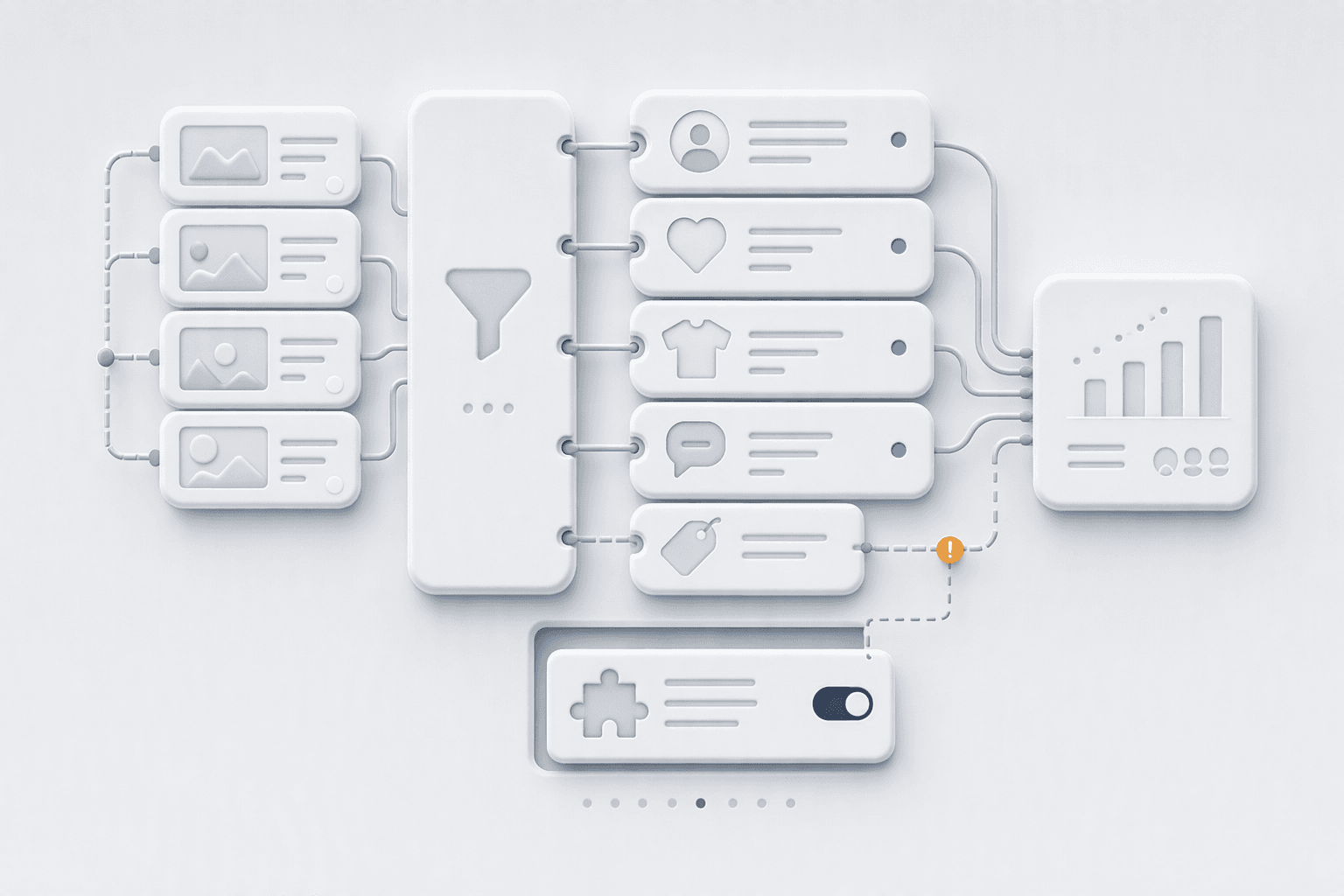
Meta ads creative testing is a core growth lever for D2C fashion brands. Meta automates audience selection and campaign delivery. Your creative must communicate the right product, problem, desire, and reason to buy.
Why Meta Ads Creative Testing Matters More for Fashion Brands
Fashion advertising has a problem other ecommerce categories do not. There are dozens of legitimate ways to sell the same product.
A black dress can sell on occasion, fit, comfort, confidence, styling, versatility, price, fabric, social proof, or the identity of the person wearing it. Those are not different captions. They are different customer angles.
That distinction matters.
You can produce 20 visually different ads and still fail. All 20 ads can communicate the same underlying idea.
This is where Meta ads creative testing becomes useful.
Stop asking which design looks better. Ask this instead:
Which customer angle creates stronger buying intent?
At Arlox.io.io, we treat this as scientific advertising, not creative approval. We isolate one variable. We test it against a metric with a pass/fail threshold. We use performance data to decide which ideas get more budget.
Meta's advertising ecosystem is moving toward automation. Recent reporting on Meta's AI-driven advertising direction highlights how campaign execution is moving away from manual targeting toward machine-led optimisation. (Forbes)
Your job is no longer manually controlling every delivery variable. Your job is feeding the system better commercial inputs.
For your fashion brand, those inputs include strong offers, relevant product information, customer insights, and a steady supply of genuinely different creative angles.
You can see how we structure that process through Arlox.io.io's Scientific Angle Testing framework.
How Should D2C Brands Test Meta Ads Creative?
Answer: Test different customer motivations and messages before testing minor visual variations.
Consider a jewellery brand launching a new necklace.
A weak testing structure looks like this:
White background image
Beige background image
Model image
Close-up image
Lifestyle image
These are different executions. They are potentially the same idea.
A stronger test looks like this:
“The everyday necklace that doesn't look basic”
“A gift she'll actually wear”
“Minimal jewellery for your everyday outfits”
“Gold-plated without the luxury markup”
“The piece that completes a simple outfit”
Now the brand is testing demand, not decoration.
This distinction is critical in India. Fashion brands compete across a wide range of price points and consumer expectations. The same principle applies when expanding from India into the UAE or US markets. The product stays identical. The motivation and cultural context change.
Research into digital advertising experimentation shows the value of structured testing over subjective creative judgement. Google has documented examples where data-driven creative optimisation produced measurable improvements in advertising performance. (Google)
For this reason, Arlox.io.io does not treat creative production as an endless request for more creatives.
The objective is more useful information per creative test.
What Should You Measure During Meta Ads Creative Testing?
A common mistake is evaluating an ad using only ROAS.
ROAS matters. It is an outcome, not a diagnosis.
During Meta ads creative testing, look at several layers of performance.
Attention:
Does the creative stop the scroll? Measure Hook Rate at 3 seconds.
Engagement quality:
Are people showing meaningful interest, not generating empty clicks?
Click behaviour:
Does the message create enough curiosity to move the user toward the product page?
Conversion:
Does the promise survive the transition from ad to landing page?
Economics:
Does the resulting cost per purchase work against your target CAC and contribution margin?
A creative can have a high CTR and still produce weak customers.
A sensational discount hook generates cheap traffic. It attracts customers who will not purchase at full price. A product-benefit angle generates fewer clicks. It produces better conversion and stronger economics.
That is why Arlox.io.io looks at the entire acquisition journey. We do not judge an ad from one dashboard metric.
To understand the broader acquisition picture, Arlox.io.io's Meta Ads Scaling approach connects creative testing with campaign scaling. We do not treat them as separate activities.
How Many Creatives Should a D2C Fashion Brand Test?
There is no universal number.
Testing 30 creatives without a hypothesis is not better than testing six well-designed angles.
A useful testing system creates variation with a reason.
For example:
Variable
Examples
Customer problem
Poor fit, boring basics, difficult styling
Desire
Confidence, convenience, status
Product benefit
Fabric, fit, durability
Social proof
Reviews, creator validation
Offer
Discount, bundle, free shipping
Format
UGC, static, founder-led, product demo
The goal is to identify patterns.
If three different creatives built around easy everyday styling outperform three unrelated concepts, you have learned something valuable about your market.
That learning influences your landing pages, product descriptions, email messaging, organic content, and future creative production.
This is where D2C fashion performance marketing becomes more than media buying.
The ad account becomes a source of customer intelligence.
Arlox.io.io's Market Research & Analysis process is designed around exactly this kind of thinking. We understand what customers respond to before blindly increasing production volume.
KEY TAKEAWAY
Meta ads creative testing is not about producing more advertisements.
It is about discovering which customer motivations consistently create profitable demand.
For D2C fashion brands, the winning system is usually:
Research → Hypothesis → Creative Angle → Test → Analyse → Iterate → Scale.
Brands that build this loop learn faster than brands that simply produce more content.
If your D2C fashion brand is spending on Meta but your creative testing feels random, book a strategy call with Arlox.io.io. You can also explore the Arlox.io.io blog for more practical Meta advertising and ecommerce scaling insights.
Written by - Evyan Kumar, Head of Marketing & Brand Growth at Arlox.io.io - a scientific advertising agency helping D2C fashion brands scale profitably on Meta. Based in Gurugram, India.